


What would it take for you to finally feel rich? A bigger retirement account? A paid-off mortgage? Enough savings that you never have to worry about money again?
Now think about the moments when you've felt most fulfilled. Maybe it was a long conversation with an old friend, a family gathering, or the satisfaction of doing something meaningful for someone else. Chances are, those experiences had relatively little to do with how much money was in your bank account. So why do we so often measure the richness of our lives in dollars?
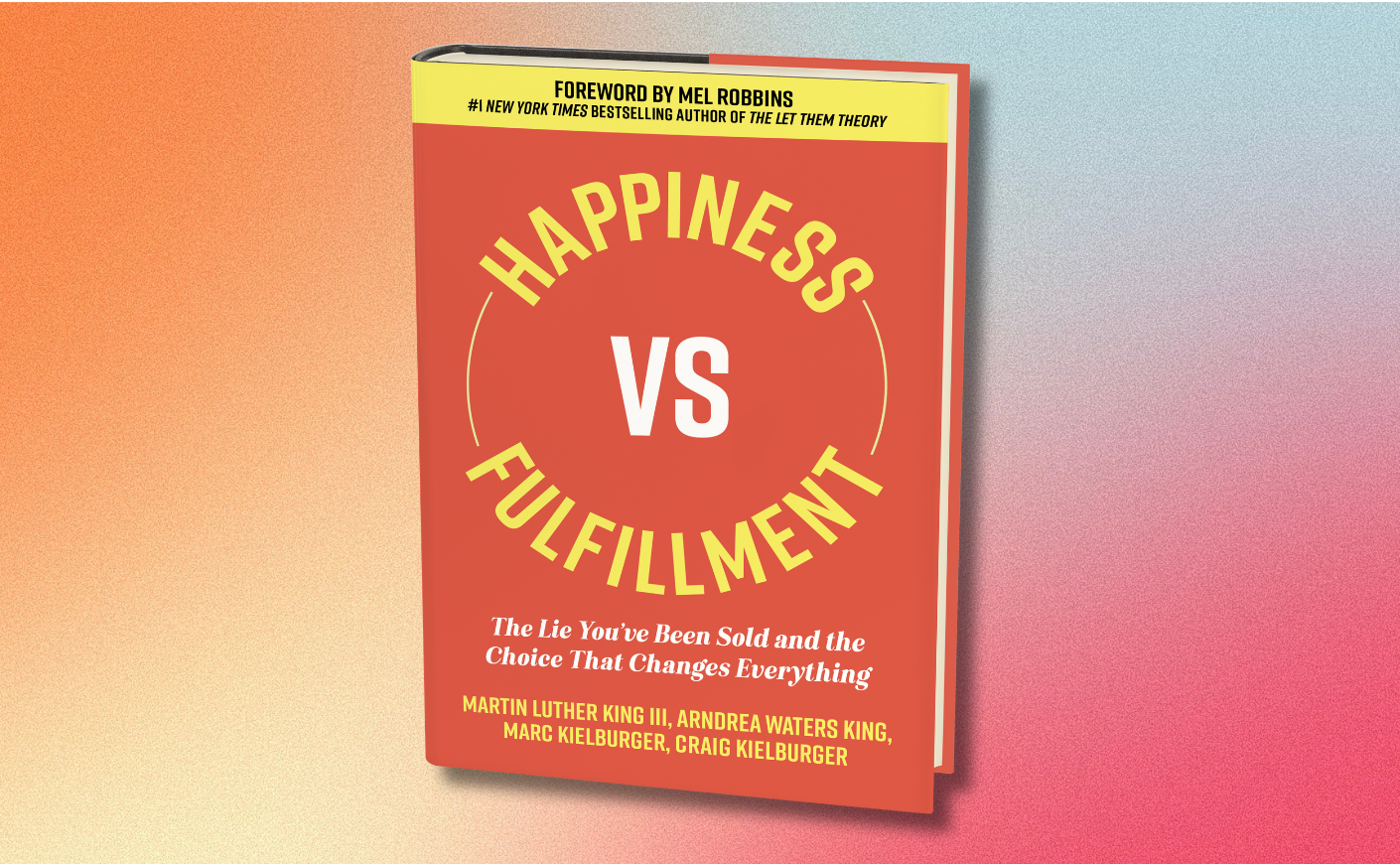
In their new book, Happiness vs. Fulfillment: The Lie You've Been Sold and the Choice That Changes Everything, authors Martin Luther King III, Arndrea Waters King, and brothers Marc and Craig Kielburger challenge the idea that happiness is something we can buy, earn, or achieve. Drawing on the teachings of Dr. Martin Luther King Jr. and research into human wellbeing, they make the case that lasting fulfillment has less to do with what we accumulate and more to do with how we live.
This exclusive excerpt from the book explores what it really means to be wealthy — and surprisingly simple ways to cultivate a greater sense of abundance, regardless of your bank balance. From rethinking how you spend your money to asking yourself one deceptively powerful question, this advice might just change your definition of a rich life.
How to cultivate a wealth mindset
Why do we link our value to bank account numbers? Why do we sacrifice health, relationships, and peace of mind for money we do not need? And what will it take to break free?
The answer starts with recognizing that you have been lied to.

The Happiness Industrial Complex has spent billions of dollars and decades of effort convincing you that money equals worth, that more is always better, that financial success is the goal.
This is a lie designed to keep you consuming, comparing, and chasing. It benefits the system, but it destroys you.
Breaking free requires a fundamental shift in how you measure wealth. It requires choosing what psychologist and activist Lynne Twist calls a “sufficiency mindset” over a scarcity mindset. In her profound book The Soul of Money, Twist writes:
“For me, and for many of us, our first waking thought of the day is ‘I didn’t get enough sleep.’ The next one is ‘I don’t have enough time.’ Whether true or not, that thought of not enough occurs to us automatically before we even think to question or examine it. We spend most of the hours and days of our lives hearing, explaining, complaining, or worrying about what we don’t have enough of . . . Before we even sit up in bed, before our feet touch the floor, we’re already inadequate, already behind, already losing, already lacking something. And by the time we go to bed at night, our minds are racing with a litany of what we didn’t get, or didn’t get done, that day. We go to sleep burdened by those thoughts and wake up to that reverie of lack . . . This internal condition of scarcity, this mindset of scarcity, lives at the very heart of our jealousies, our greed, our prejudice, and our arguments with life.”
She contrasts this with sufficiency: “Sufficiency isn’t an amount at all. It is an experience, a context we generate, a declaration, a knowing that there is enough, and that we are enough.”
This shift from scarcity to sufficiency is not about settling for less. It is about recognizing what you already have and letting that be enough. It is about measuring wealth not by what you lack, but by what you possess: love, health, relationships, purpose, freedom, beauty, joy.
We recognize that we are asking you to go against the cultural mindset that money equals wealth. This is not easy. You will be swimming upstream against the dominant messages of your society. But we promise there is liberation in this. Below are some ideas on how to break free from the traditional mindset that money equals wealth.
Practice gratitude for what you have
Begin each day by acknowledging three things you already possess that money cannot buy. Perhaps that's your health, your relationships, your ability to witness beauty, or your capacity for growth.
Gratitude is not just positive thinking. It is a practice that rewires your brain away from scarcity and toward sufficiency. Research shows that regular gratitude practice increases life satisfaction, reduces materialism, and strengthens relationships.
When you train your attention on what you have rather than what you lack, you begin to feel wealthy regardless of your bank balance.
Invest in experiences over possessions
Research consistently shows that spending money on experiences creates more lasting happiness than spending money on things. Experiences connect us to others, create memories, and become part of our identity in ways that possessions never do.
The new car provides a brief thrill, then becomes normal. But the camping trip with your children, the concert with your partner, the volunteer project with your community — these create joy that compounds over time as the memories are revisited and shared.
Choose experiences that build connection and meaning over purchases that promise status.
Prioritize relationships over recognition
Your wealth is determined far more by the quality of your relationships than the size of your portfolio. A life rich in love, friendship, and community is a wealthy life, regardless of financial status.
Invest time in the people who matter. Show up for others. Build genuine connections based on who people are, not what they can do for you. Let go of relationships that are transactional or status driven.
Define your own "enough"
One of the most powerful questions you can ask yourself is, “What is enough for me?”
Not what society says is enough. Not what your neighbors have. Not what Instagram influencers display. What is actually enough for you to feel secure, comfortable, and free?
When you define your own “enough,” you create a finish line. You can actually arrive. You can experience sufficiency. This is radically countercultural, but it is also radically liberating.
Craig remembers a conversation in his MBA program about “your number.” Everyone in his study group had one: the amount they needed to earn to feel successful, secure, and free. They were in their twenties, unmarried, eating ramen noodles, and their numbers felt ambitious but achievable.
Twenty years later, Craig stays in touch with that study group. They’ve all hit their numbers. Every single one. You could say they didn’t aim high enough, but that’s not quite right. The truth is simpler and more troubling: The number kept rising.
One classmate just finished building a custom home. Another just purchased a third property. As soon as they reached their original number, the goalpost moved. What once seemed like “enough” to guarantee freedom became just the baseline for a new, higher number.
Society trains us to ask “what is your number?” as if wealth were a finish line you cross into permanent satisfaction. But that’s the wrong question. The right question is: “What is enough?”
Because “enough” is freedom. A moving target is a trap. If your number keeps rising every time you reach it, you’re not building wealth. You’re building a prison.
Measure success by contribution, not accumulation
Dr. King taught us that life’s most persistent and urgent question is, “What are you doing for others?” This is the measure of a meaningful life.
When you shift your focus from what you are accumulating to what you are contributing, wealth takes on an entirely different meaning. Your richness is measured not by your bank account but by your impact, your generosity, your service.
Ask yourself regularly: How am I using what I have (my time, my resources, my gifts, my energy) to serve something greater than myself? The answer to that question reveals your true wealth.
Cultivate health as your foundation
Prioritize your physical, mental, and emotional wellbeing above financial gain. Make time for exercise, sleep, healthy food, and stress management. These are not luxuries; they are fundamental to a wealthy life.
Remember that all the money in the world cannot bring you back to health once it’s lost. But living from fulfillment naturally supports the habits that create lasting vitality.
Your health is your first wealth. Guard it carefully.
Practice generosity
One of the paradoxes of wealth is that it often increases when it’s shared. Generosity creates a felt sense of abundance. When you give your time, attention, resources, or care, your brain updates its internal model of the world to say: I am someone with enough to share. That felt experience directly counters scarcity, which is defined not by how much you have, but by the chronic sense that it is never enough.
This isn’t philosophy dressed up as science. A substantial body of research shows that people who regularly engage in generous behavior report higher life satisfaction, greater meaning in life, and stronger emotional wellbeing. Generosity quite literally makes you feel wealthier.
Studies demonstrate that spending money on others produces more lasting happiness than spending it on oneself, even when controlling for income level. Neuroimaging research further shows that acts of giving activate reward-related brain regions, including the ventral striatum and medial prefrontal cortex, the same circuitry involved in pleasure, motivation, and value. In other words, generosity doesn’t just feel good metaphorically. It is processed by the brain as a genuine reward.
Other data suggest the effects are not fleeting. Individuals who volunteer, help others, or engage in prosocial behavior show lower mortality risk, reduced inflammation, and better mental health over time. These benefits appear to be strongest when generosity involves direct human connection rather than abstract or purely transactional giving.
Craig and Marc run a charity called Legacy+ that helps individuals build positive movements for social change. They help people activate a cause or issue they care about, and bring it to millions of others, creating tangible and measurable impact.
One of the people they have worked with is an amazing woman named Cat Miller, who founded a wellbeing platform called ThisWayUp. It is all about supporting the mental health of women and girls, and it offers free, research-backed resources like expert-led videos, practical tools, and real stories to help manage mental health challenges. Cat was inspired to start it because of her own experiences with depression and seeing her daughter struggle with anxiety. She wanted to create a welcoming, ad-free space where others could find the support they needed. By helping others, Cat found her own voice and is living her purpose.
Another movement Legacy+ helped create is Say It Now, founded by Walter Green. Walter’s idea was simple but powerful: Express gratitude to the people who matter while they are still alive to hear it.
The inspiration came from a painful moment. While eulogizing a close friend who had recently passed away, Walter realized his friend would have loved hearing all these kind words while he was still alive. Why do we wait until someone is gone to tell them what they meant to us?
Walter decided to act. Over the course of a year, he traveled to meet, in person, with every key figure who had shaped his life. He looked them in the eye and expressed his gratitude. He thanked them. He told them what they meant to him.
He then built a movement around this practice. Say It Now has inspired millions of people in dozens of countries to stop waiting and start expressing appreciation now. There is an official “Say It Now Day” celebrated in the United States. Walter has also produced a book and documentary to help people get started.
The message is urgent and clear: Say it now. Not at the funeral. Not when it’s too late. Now.
Practicing generosity can equally be as simple as offering your full presence, listening without distraction, mentoring, showing up consistently, or helping without expecting a return. These small, repeated acts train the nervous system out of scarcity and into sufficiency. Over time, generosity reshapes how you experience what you already have. Not richer on paper, but wealthier where it actually matters.
Disconnect your worth from your net worth
Perhaps most importantly, recognize that you are not what you own. Your value is not determined by your salary, your house, your car, or your bank balance.
You are valuable because you exist. Because you are capable of love. Because you are part of the human family. Your worth is inherent, not earned.
When you internalize this truth, the opinions and judgments based on financial status lose their power. You become free to define success on your own terms and to pursue fulfillment without needing external validation.
Martin Luther King III is a global human rights advocate and the eldest son of Dr. Martin Luther King Jr. and Coretta Scott King. A champion for nonviolence and social justice, he has inspired millions, advised heads of state, and led civil rights initiatives on nearly every continent. Martin served two terms on the Fulton County Board of Commissioners before leading the Southern Christian Leadership Conference, which was founded by his father. He continues his father’s legacy through his work with the Drum Major Institute, focusing on poverty, racism, and militarism. He is the cohost of the award-winning My Legacy podcast.
Arndrea Waters King is president of the Drum Major Institute and a passionate advocate for social justice and equality. She organized the first National Conference on Hate Crimes and Hate Violence, partnering with over one hundred national organizations. Arndrea’s work with the Center for Democratic Renewal (formerly known as the National Anti-Klan Network) and civil rights icon Dr. C. T. Vivian, a lieutenant of Dr. Martin Luther King Jr., has been instrumental in advancing civil rights. She coauthored When Hate Comes to Town: Faith-Based Edition and has written numerous articles and publications. She has spoken before mass crowds as a champion of democracy, justice and human dignity. She is the cohost of the award-winning My Legacy podcast.
Marc Kielburger is a New York Times bestselling author, Harvard graduate, Rhodes Scholar, and Oxford-trained lawyer. A trailblazing movement builder who has collaborated with leaders like Oprah Winfrey and brands like Virgin Group, he has headlined more than 130 live stadium events, inspiring millions, and has received ten honorary degrees. He is the cohost of the award winning My Legacy podcast and the cofounder of Unlimited Life, an organization dedicated to helping people live their longest, healthiest, best lives. A certified reiki master and certified health coach, Marc brings a holistic, purpose-driven approach to wellbeing, leadership and transformation.
Craig Kielburger is a New York Times bestselling author and social entrepreneur whose research examines what creates a life of lasting fulfillment through purpose, contribution, and legacy. He holds a doctorate in organizational development and change, a master’s in human development, an MBA, and sixteen honorary doctorates. Craig is the cofounder of Legacy+, an organization that operates large-scale social impact initiatives. A recipient of the Order of Canada, the Roosevelt Freedom Medal, and the Nelson Mandela Human Rights Award, he has spent three decades building movements that have engaged millions in service and lasting impact.
