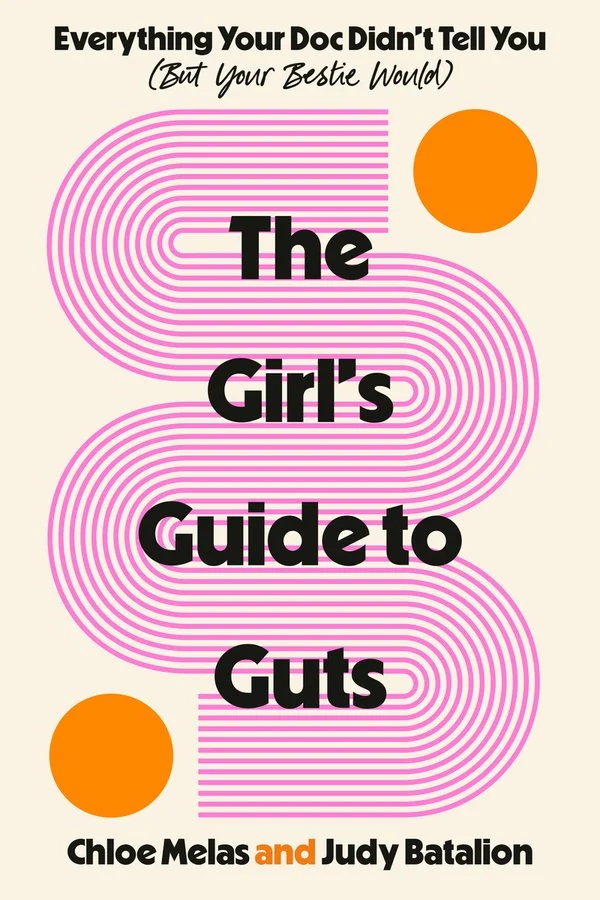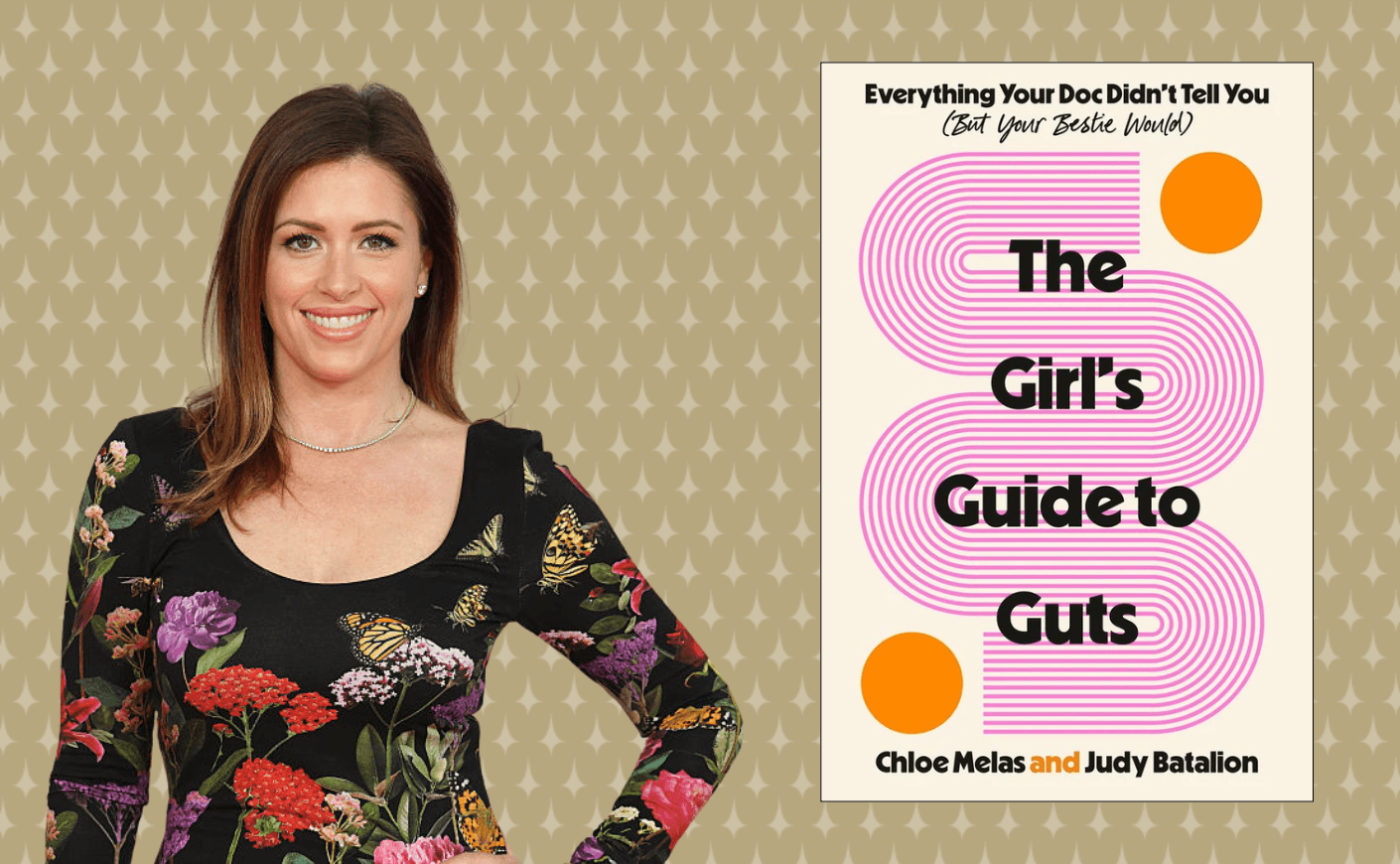
My friend Chloe Melas is getting real about gut health — and she’s not sparing the embarrassing details. The NBC News entertainment correspondent was diagnosed with ulcerative colitis, a form of inflammatory bowel disease (IBD), at 25. For 15 years, she kept her illness largely private while building her journalism career. Now she’s opening up in her new book, The Girl’s Guide to Guts, co-written with Judy Batalion, who also has ulcerative colitis.
Chloe and Judy tackle the questions that can be hard to ask out loud: How do you date, travel, work, or raise kids when you’re worried about making it to the bathroom? They share their own stories, along with advice from experts, and bring some much-needed humor to the conversation. Below, Chloe tells me what she’s learned about living with a chronic illness and speaking up for herself. I’m sure her candor will help so many women feel less alone — and help take the stigma out of talking about our guts.
Katie Couric: Chloe, what were your first symptoms?
Chloe Melas: One day when I went to the bathroom, I noticed some blood on the toilet paper. But I ignored it for a few weeks before finally calling to tell my mom. She was very concerned and told me I needed to see a gastroenterologist. She was right: I eventually had a colonoscopy and was diagnosed with ulcerative colitis, a form of IBD.
What is the difference between IBD and IBS?
Great question! IBD is Inflammatory Bowel Disease which affects a little over 3 million people in the United States. There are two types: Ulcerative Colitis which is when your body is attacking its own colon and rectum and Crohn's in which the disease can start to appear anywhere from your mouth and all the way through the digestive tract. You need to be diagnosed with a colonoscopy.
IBS is Irritable Bowel Syndrome, which affects 45 million Americans. The symptoms — which can present as abdominal pain, food sensitivities, constipation and/or diarrhea — are thought to be a disruption between how the gut and brain communicate with each other. Once you rule out that you don't have IBD or anything else, you can do the food elimination diet to find the triggers that may cause your symptoms.
What other topics do you tackle in the book?
My co-author, Judy — who also has ulcerative colitis — and I didn't want to write only about our years living with IBD. We wanted to broaden it to delve into IBS, celiac disease, diverticulitis, and colon cancer since all of these issues are drastically on the rise. We interviewed countless experts: from gastroenterologists, to a surgeon, an expert on the microbiome, a pain management doctor, and even experts on meditation, exercise, and psychology.

You really put it all out there. Were you embarrassed to share such personal stories?
Honestly, not really. I know that the only way to build community, share knowledge, and shed stigma is to talk openly and honestly. Our book really gets candid because I wanted to show women everywhere that a chronic illness doesn't have to derail your dreams. When I was first diagnosed, I thought I'd never find love, pursue a big career, or travel the world anymore — but I was wrong. Through really funny stories, if I may say so myself, we hope that our relentless determination to power through encourages others to do the same.
What's the most fascinating thing that you learned while researching for the book?
There were so many things I learned. I had no idea that 90 percent of your serotonin is produced in your gut. No wonder that if your gut is off, you may experience changes in mood. I also couldn't believe that in 2008 during an archaeological dig in Italy, it was revealed that a young woman from around 2,000 years ago showed signs of celiac disease. Oh, and you have taste buds in your digestive tract!
You have a lot of celebrities who blurbed the book, from Kris Jenner and Christie Brinkley to Paige DeSorbo. How did that come about?
Given that I've been covering entertainment news for nearly 20 years, I wanted to incorporate that somehow into the book. In the early stages of the book I had an idea to interview celebrities who either had IBD or had been open about having IBS. But I couldn't find many well-known women with IBD who had spoken publicly — and the ones with IBS I reached out to didn't want to be interviewed. That's what led us to interview experts, and I'm so glad we did! I ended up reaching out to female celebrities I admired who had platforms that could make an impact and was overjoyed when women like Kris, Christie, Paige, Kendra Scott, Sara Sidner, and many others wanted to provide quotes of support for the back cover. It all worked out in the end!
You share a lot of tips in the book, on everything from dating to fertility. Can you share some of your favorites here?
Don't wear white! I'm only half kidding. But I was wearing all white when I didn't make it to the bathroom at the Sundance Film Festival after meeting Chelsea Handler. If you want to know more, you need to read the book! Call a restaurant before you go to find out the bathroom situation — how many are there, how many stalls — and always read the menu in advance.
The book has a section called "Doctor Divorce" — what is that?
For years, I stayed with a doctor who wasn't right for me. I joke in the book that I wish there were an app to match you with the right doctor. I have so many friends that tell me how much they wish they could switch doctors, but that they feel guilty. We interview a patient advocate in the book who talks you through how to trust your gut and switch it up!
You write about a recent flare-up and how hard it's been to parent. What advice do you have for people dealing with a disease while also trying to show up for their kids?
Give yourself grace. I've missed my kids' soccer games because I couldn't be too far from the bathroom. I've canceled plans from the toilet and my kids have seen me take baths in the afternoon just to find some relief. It's not easy, but neither is raising children. But I truly believe God only gives you what you can handle. I try to just focus on the things I can control and know that I'm a wonderful mother in many ways and to not be so hard on myself when my body can't keep up.
What's your hope for the book?
That readers will join our bowel movement movement and spread the word to hopefully save lives!
This interview has been edited for length and clarity.
The Girl's Guide to Guts is available now.