


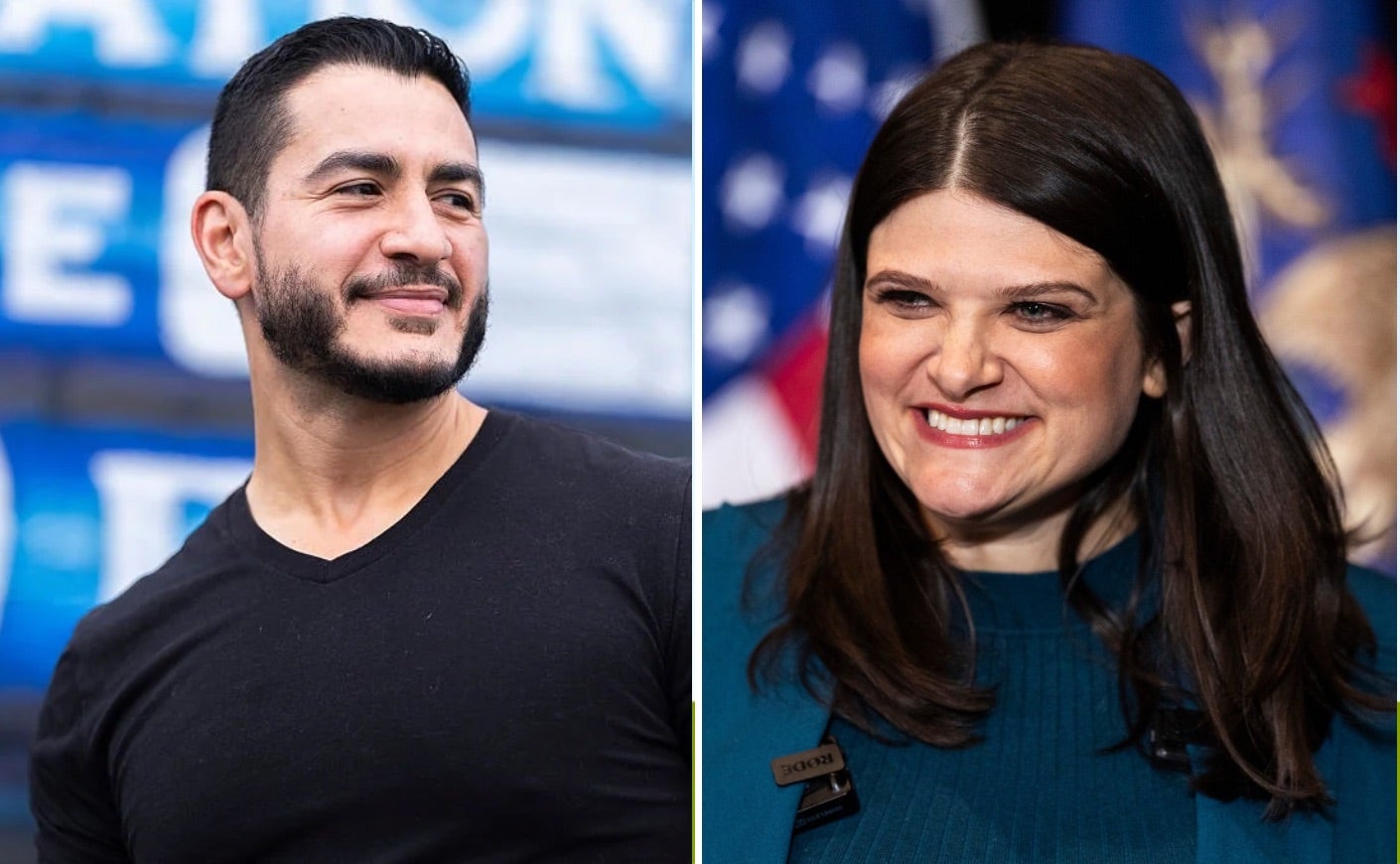
Michigan Democrats were supposed to be spending the final days before the election rallying behind their Senate nominee. Instead, they’re dealing with a primary rivalry that never quite cooled off.
After Abdul El-Sayed defeated Rep. Haley Stevens by less than a percentage point in August's Democratic primary, Stevens endorsed him. But their long-running disagreements over Israel persisted — and over the weekend, they erupted into a public falling-out, with Stevens backing his Republican opponent, Mike Rogers.
With a seat — and potentially control of the chamber — at stake, the split comes at a particularly difficult moment for the party. Here’s how the tensions escalated and what they could mean for Democrats on Election Day.
Why are Haley Stevens and Abdul El-Sayed feuding?
The clash centers on a digital ad from Rebellion PAC, an outside group led by The Young Turks founder Cenk Uygur, linking Americans’ grocery costs to U.S. military aid to Israel. In it, a shopper tells a man to skip buying eggs because “we have to set that $7 aside for killing Palestinians.” Stevens called the message “fearmongering” and joined other critics in condemning it as antisemitic. (As for Uygur, he has defended the ad, maintaining that it targets Israel, not Jewish people).
El-Sayed distanced himself from the ad, saying the group had nothing to do with his campaign. Speaking to reporters Wednesday, he also said his opposition to military aid wasn’t limited to Israel. “I don’t think we should be funding foreign militaries generally,” he said, naming Egypt, Saudi Arabia, Qatar, and the United Arab Emirates.

That same day, Stevens said she wouldn’t campaign with El-Sayed again before Election Day. Democratic Rep. Debbie Dingell tried to broker peace, helping arrange a Sunday “unity rally” at a Detroit church with Stevens, El-Sayed, and South Carolina Rep. Jim Clyburn.
But by Friday, it was clear that plans for a joint appearance hadn’t eased the tensions. Stevens called on El-Sayed to condemn the ad and apologize for comments that she said blamed Israel for Michigan’s inability to afford schools, health care, and child care. “A disclaimer is not a condemnation,” she wrote as part of a statement posted on X.
El-Sayed accused Stevens of “relitigating a primary that ended three months ago” when Democrats should be focused on defeating Rogers. On Saturday, he directly rejected the ad’s message, telling reporters: “I’ve already been clear that that ad was not made by me and I do not agree with the contents of that ad.”
But efforts to present a united front soon fell apart. El-Sayed disinvited Stevens from Sunday’s appearance and asked her to stay away from his campaign events to keep their feud from overshadowing the issues in the campaign’s final days, unnamed sources familiar with the situation told Politico. Dingell separately said she asked Stevens not to attend and that Stevens agreed.
By Sunday, Stevens was at a different Detroit church alongside Rogers — whom she went on to endorse for Senate.
Why did Haley Stevens endorse Mike Rogers?
In a video announcing her decision, Stevens said El-Sayed’s campaign told her she was no longer welcome at its events, while still describing herself as “a very proud Democrat.” It was a striking reversal: Stevens previously told CNN she still planned to vote for El-Sayed, even as her fiancé, Jason Turkish, a major Democratic donor who is Jewish, announced that he would vote for Rogers.
El-Sayed didn’t appear fazed. “At the end of the day, I actually don’t think about Haley Stevens,” El-Sayed told reporters, flanked by Democratic Sen. Angela Alsobrooks and Democratic Rep. Jim Clyburn. “This is a state of 10 million people who deserve a lot better from the government. I’m a lot more focused on the 9,999,998 that are not the ones you guys are talking about.”
The reaction inside Stevens’s own office was more dramatic. In a statement first shared by CNN, her longtime chief of staff, Justin German, said Sunday morning, “Many members of our team have resigned, including myself.” When Katie Couric Media reached out to her communications director, Logan Basch, an automatic email reply confirmed his departure: “Hello, as of November 1st I am no longer with the Office of Congresswoman Haley Stevens.”
Democratic leaders rallied around El-Sayed in the wake of the endorsement. Senate Minority Leader Chuck Schumer called Stevens’s decision “a despicable betrayal,” while former House Speaker Nancy Pelosi said Stevens “has chosen to dangerously betray Michigan families’ healthcare, freedoms and future." House Minority Leader Hakeem Jeffries didn’t mention Stevens by name but urged voters to support El-Sayed, calling his election “critical to flipping control of the United States Senate.”
The endorsement comes as Democrats fight to hold the Michigan Senate seat being vacated by Democratic Sen. Gary Peters. The state party blasted both Stevens and Rogers in a statement. “Mike Rogers is Donald Trump’s hand-picked candidate for Senate, a rubber stamp for Trump’s toxic agenda, and a corrupt politician looking out only for himself,” said Michigan Democratic Party Chair Curtis Hertel.
President Trump, meanwhile, welcomed Stevens’s endorsement, praising her “bravery” in crossing the political aisle.
Could this split cost Democrats?
It could, especially with a Senate seat on the line. El-Sayed and Rogers are competing to replace retiring Democratic Sen. Gary Peters, and losing Michigan would make Democrats’ path to a Senate majority harder.
El-Sayed has an edge in the polls: RealClearPolling’s average of surveys conducted through Oct. 29 puts him at 49.3 percent to Rogers’s 45.4 percent, a 3.9-point lead. But those polls were taken before Stevens’s endorsement, so they don’t capture any potential fallout.
The spat reflects a broader divide within the party over Israel and the war in Gaza. For El-Sayed, the challenge is holding together a coalition that includes voters demanding an end to U.S. military aid to Israel and others concerned about antisemitism and his association with Hasan Piker, a popular left-wing Twitch streamer who has controversially said Hamas is "a thousand times better” than Israel.
Stevens’s endorsement could help Rogers win over Democrats who share her concerns, though it’s too soon to know how many will follow her lead. For now, the party risks spending its final days fighting with itself instead of making its pitch to voters.
