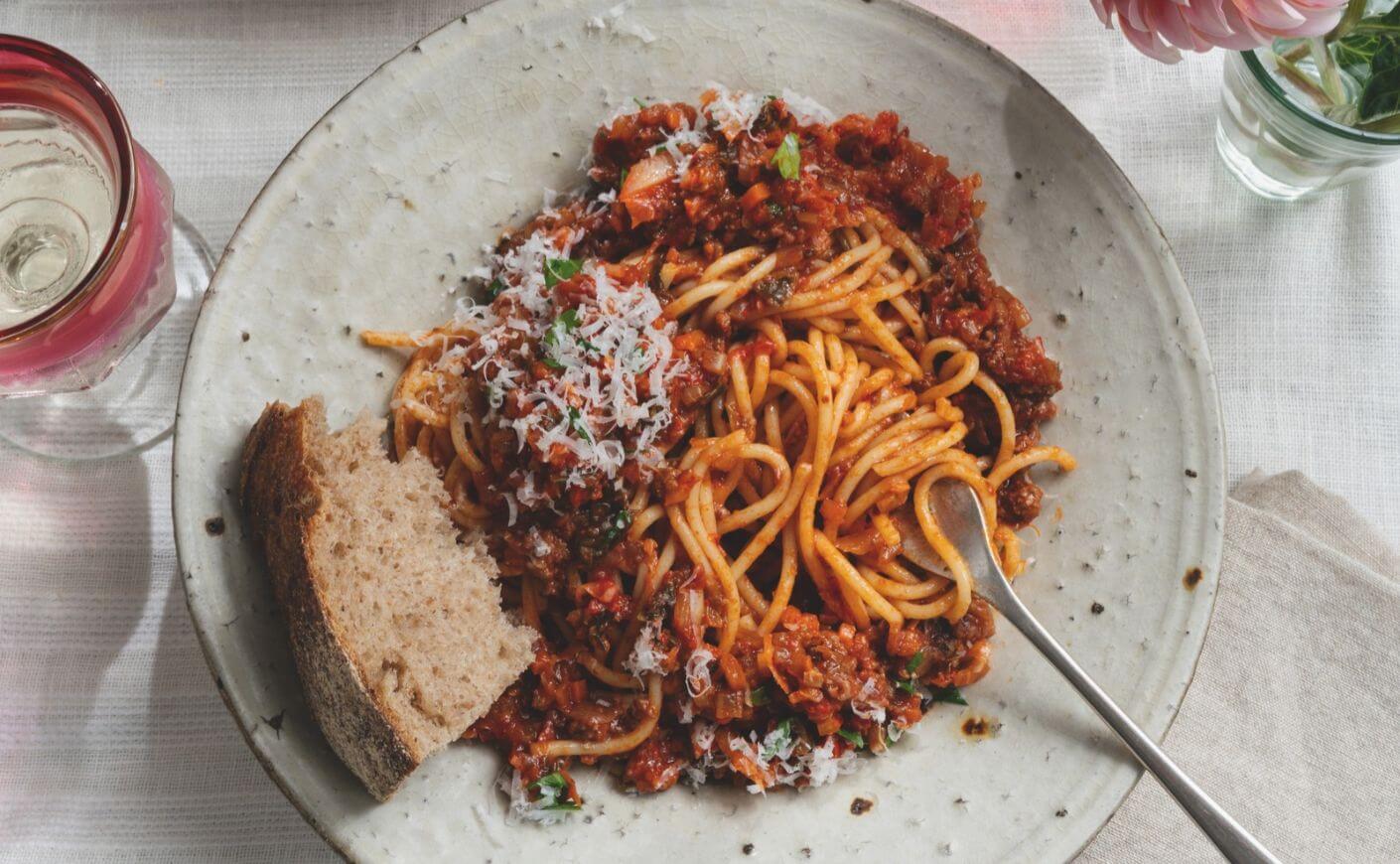
"I’ve always loved Italian American food," Esther Choi writes in her new book, Hand Taste. "Maybe because Italian and Korean cooking have traits in common: Both are homey and resourceful, and grandmothers are revered for their signature dishes made without formal recipes." If you're unfamiliar with Korean cuisine, Choi's comforting, satisfying spin on bolognese is the perfect introduction.
"This recipe was one of the first Korean Italian fusion recipes I developed, " Choi continues, "and it makes use of my two favorite secret weapons: kimchi and fish sauce." While these ingredients are notoriously pungent, Choi uses them in moderation so that they jazz up the pasta without overtaking it. "The result is the Bolognese you know and love, but with a deep, tangy twist."
"Fish sauce in Italian cooking is not a new idea, actually," Choi points out. "Romans have been using salted anchovies and garum, an ancient kind of fish sauce, for centuries. For an extra-special finish, I love garnishing this with baek (white) kimchi for acidity. But it’s optional, and regular kimchi (or no kimchi) works just fine, too."
Once you experience this mouthwatering, robust dish, you'll crave a Korean take on all of your Italian favorites.
Kimchi Bolognese
Author: Esther Choi
Prep Time: 15 min
Cook Time: 40 min
Calories: 680 calories per serving
Servings: 4-6 servings
Ingredients
Bolognese sauce
- 2 tablespoons extra-virgin olive oil
- 1 medium yellow onion, finely diced (about 1½ cups)
- 2 carrots, peeled and finely diced
- 3 stalks celery, finely diced
- 4 cloves garlic, minced
- Kosher salt
- 1 cup chopped kimchi
- 1 tablespoon tomato paste
- ½ cup red wine
- 1 pound ground beef
- 1 (28-ounce) can whole San Marzano tomatoes
- 1 cup beef broth o rwater
- ½ teaspoon dried Italian seasoning or dried oregano
- Freshly ground black pepper
- 2 tablespoons fish sauce, plus more to taste
To finish
- Kosher salt
- 1 pound spaghetti
- 1 cup chopped kimchi (white or regular), optional
- 2 tablespoons chopped flat-leaf parsley
Directions
- Start the Bolognese sauce: Heat the oil in a large Dutch oven or pot over medium-high heat. Stir in the onion, carrots, and celery. Cook, stirring occasionally, until the onions have softened and the edges start to brown, about 4 minutes. Stir in the garlic and a pinch of salt and cook for 30 seconds, then stir in the kimchi and tomato paste and cook until the kimchi pieces start to soften, about 3 minutes. Pour in the wine, increase the heat, and simmer, stirring with a wooden spoon to dislodge any bits that have stuck to the bottom, until the wine has nearly disappeared, about 2 minutes.
- Add the meat: Stir in the beef, season with generous pinches of salt (at least ½ teaspoon), and cook, breaking up the beef into small pieces with a wooden spoon, until cooked through, 6 to 8 minutes.
- Add the tomatoes: Pour the tomatoes in a bowl. Using clean hands, squish the tomatoes into small pieces. Pour the tomatoes into the pot and add the broth, Italian seasoning, a pinch of salt, and a few grinds of black pepper. Bring to a simmer and lower the heat to medium-low. Gently cook, stirring occasionally, until the sauce is just thick enough to stand up on a spoon, about 20 minutes. Stir in the fish sauce and taste, then add more salt or fish sauce if needed.
- Cook the noodles and serve: In a pot of boiling salted water, cook the spaghetti according to package instructions, stirring occasionally to prevent sticking, until al dente. Drain the noodles in a colander, then give the colander a shake to get rid of extra water. Divide the noodles among serving plates and spoon the Bolognese on top. Garnish with white kimchi (if using) and parsley and serve.
Leftover Bolognese sauce (without the noodles) keeps in an airtight container in the refrigerator for up to 5 days, or in the freezer for up to 2 months.
Excerpted from Hand Taste by Esther Choi. Copyright © 2026 by Esther Choi. Photograph by Janice Chung. Used with permission of Voracious, an imprint of Little, Brown and Company. New York, NY. All rights reserved.