


When you picture a visit to a cardiologist, you probably imagine blood pressure cuffs, cholesterol tests, and maybe a conversation about medication. You might not expect to spend much time talking about how well you sleep, what you eat, how stressed you feel, or which nutrients you may be missing.
For Arash Bereliani, MD, those questions are non-negotiable.
Dr. Bereliani is board-certified in cardiovascular disease and internal medicine and serves as a clinical associate professor of medicine and cardiology at UCLA’s David Geffen School of Medicine. He’s also on staff at Cedars-Sinai Medical Center and serves as medical director of the Beverly Hills Institute of Cardiology and Preventive Medicine. His work focuses on preventive cardiology and an integrative approach that considers lifestyle, nutrition, and other factors alongside conventional treatments.
That interest in prevention also informs his work in women’s heart health. His book, What About Her Heart? How a Male-Modeled Medical System Is Putting Women's Hearts at Risk, examines the ways women’s cardiovascular symptoms and risk factors can be overlooked.
We spoke with Dr. Bereliani about what integrative cardiology actually means, why he believes prevention needs to start long before symptoms do, and how he evaluates the increasingly crowded world of vitamins and supplements. He also explained what caught his attention about research on cocoa flavanols and cardiovascular health, and why getting them from chocolate isn’t quite as simple as it sounds.
Katie Couric Media: Let’s start with the basics: What does integrative medicine mean in the context of your cardiology practice?
Dr. Arash Bereliani: In cardiology, we’re very good at treating conditions like heart attacks and heart failure, but we’re not as good at prevention. My goal is to prevent the disease before it forms.

When it comes to prevention, a lot of it revolves around lifestyle, diet, nutrition, vitamins, and supplements. That’s when I started becoming interested in what I call “integrative cardiology.”
Integrative means combining the best of the whole world — the best treatments, not just medication. It includes combining diet, lifestyle, stress reduction, supplements, and vitamins to create an optimized treatment plan for diseases. You can think about it as a holistic approach to a cardiology or heart problem.
Was there a particular moment when you realized you wanted to practice this way?
I’ll never forget a patient I had during my cardiology fellowship at UCLA. She was in her early 50s, dealing with multiple cardiovascular risk factors like high blood pressure, and was taking several medications. Despite being highly compliant with her prescriptions, her overall lifestyle was still holding her back. Her diet was poor, she wasn’t exercising, and her stress levels were incredibly high.
That was a major turning point for me. I realized that writing prescriptions wasn't enough; we had to address the whole person — integrating lifestyle, nutrition, and stress management to help people optimize their health before major events occur. She followed me to my preventive practice, and today, after transforming her diet and exercise, she has lost over 50 pounds and is thriving.
If I came to you and said, “I want to take better care of my heart,” what might you ask about that I wouldn’t necessarily encounter during a standard cardiology visit?
The first thing I would do is spend more time on what a typical visit skips, like sleep, stress, and diet. For women, I spend a lot of time getting a good history about their pregnancy — things like gestational diabetes — and menopause. Pregnancy and menopause are very important inflection points in a woman’s life that can increase the risk of heart disease.
The second thing I do is very specific advanced testing. I look at things like nutrients, biomarkers, inflammatory markers, and, if needed, genetics. I want to know the person’s biology and biochemistry because everybody is different.
The third thing I do is create a customized, individualized plan that combines lifestyle, nutrition, supplements, and, if needed, medication.
Is that approach only for people trying to prevent heart disease, or do you use it with patients who already have cardiovascular disease?
I use it with both. Somebody who already has heart disease can still have nutritional deficiencies or inflammation. All of these factors can still play a role.
The things we do for prevention can also apply to someone who already has heart disease. We can integrate nutrition, lifestyle, exercise, stress reduction, supplements, and vitamins alongside conventional treatment.
What can someone do for their cardiovascular health long before they ever have symptoms?
I tell my patients to know at least four numbers about themselves. Number one: What’s your sugar level? What’s your A1C? Are you prediabetic or diabetic? Number two is your cholesterol numbers. Number three: Know your blood pressure. And number four: Know your waist size. Then educate yourself about heart disease and prevention. Lifestyle is the most important thing. Nutrition, exercise, a good night’s sleep, and stress reduction are all very important.
Remember, heart disease is a 20-year project. If you have a heart attack at 50, the process probably started 15 or 20 years before. It’s important to start taking care of yourself when you’re young, not when you already have heart disease.
So many supplements and wellness trends compete for our attention. As a doctor, how do you separate something with meaningful science behind it from hype?
I’m so glad you brought this up because I talk to my patients about it all the time. A lot of people hear about a supplement from a friend, see it on TV or social media, and then buy it. I don’t think that’s the way to do it.
I use five criteria. Number one: I need to know the mechanism of action. How does it work? Does it scientifically make sense? Number two: I need to see human randomized trials. Number three: I need to know the dose. Is there a defined or standardized dose? Number four: I need to know there is safety data. And number five: I want the product to be standardized.
Researchers have studied cocoa flavanols in relation to cardiovascular health. What interested you about them?
First, the data on cocoa flavanols is incredibly compelling because it checks all the boxes I just mentioned: we understand the mechanism of action, have extensive safety data, and we have remarkable human randomized trials — most notably, the COSMOS trial. It’s very rare for a study to excite me, and this one did because it was done so well.
Let’s talk about that study. COSMOS followed more than 21,000 older adults and found a 39 percent reduction in cardiovascular death among those who took their supplement consistently in accordance with the study protocol. What stood out to you about those findings?
What impressed me first was the sheer scale and scientific rigor of the trial — following over 21,000 generally healthy older adults for over three years. It's very rare for a dietary intervention study to have that population size and a double-blind, placebo-controlled design.
Secondly, I was thrilled to see that more than half of the participants were women. Historically, women have been underrepresented in cardiovascular research, so having such a robust female cohort makes these findings exceptionally meaningful.
The trial showed that daily intake of 500 mg of cocoa flavanols supported significant cardiovascular health biomarkers, while maintaining an excellent safety profile.
What do cocoa flavanols actually do in the body that could affect cardiovascular function?
Cocoa flavanols are compounds found in plants. You can think about them as plants’ way of protecting themselves. They’re part of a broader group of compounds called polyphenols. One form of cocoa flavanol shown to be very effective for circulation is (-)-epicatechin. It helps produce nitric oxide.
Imagine blood vessels: their inner lining has a layer called the endothelium. Nitric oxide, you can think of it as a relaxer of the blood vessels. It signals blood vessels to relax and widen, increasing blood flow and improving circulation. That’s the main mechanism of cocoa flavanols.
Someone reading this might think, “Great, I’ll just eat more dark chocolate.” Why isn’t that the same thing as taking a cocoa flavanol supplement?
Everybody thinks cocoa and chocolate are the same, but they’re absolutely not. Making chocolate from the cocoa plant involves a lot of processing. Cocoa flavanols are very fragile and can be easily wiped out. During the chocolate-making process, fermentation and other steps can wipe out the vast majority of cocoa flavanols.
There’s also a process called Dutching that chocolate makers use to make cocoa darker and milder, and that process can wipe out most of the flavanols. So the biggest message here is that chocolate and chocolate products, even dark chocolate, may not have enough cocoa flavanols. If you want to benefit from cocoa flavanols, you need to know how much you’re actually getting.
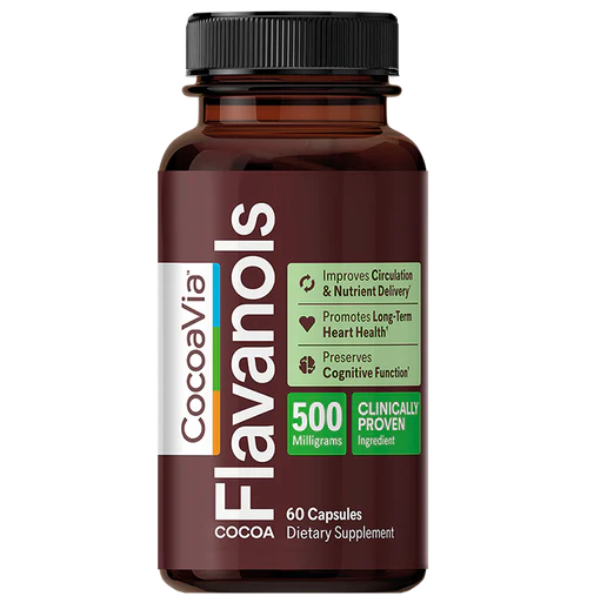
COSMOS tested a cocoa extract providing 500 milligrams of cocoa flavanols a day. CocoaVia offers that same daily amount through its standardized CocoaPro extract. Why does that standardization matter?
I work with CocoaVia because I believe in their special process, called the CocoaPro process, designed specifically to retain the cocoa flavanols.
The second reason I love CocoaVia is that the product is standardized, so you know what you’re getting. That’s very important to me. When I evaluate a supplement, I want to know the dose, and I want the product to be standardized so you know how much you’re getting each time.
After everything you’ve seen in your career as a cardiologist, what’s one thing you wish more people understood about taking proactive care of their heart?
The main thing is: Don’t wait for symptoms to take your heart seriously. I tell my patients the best time to care for your heart is before it asks.
If you’re young and healthy, or you have risk factors but don’t have heart disease, see a doctor who knows about prevention. My recommendation to women is to know your symptoms. Women’s symptoms can be very different from men’s. If something doesn’t feel right, be an advocate for yourself. Tell your doctor and ask them to check your heart. And know your numbers, as I mentioned before.
If something doesn’t feel right and you’re not sure if it’s your heart, don’t assume it’s stress or anxiety. Be an advocate for yourself.
Try CocoaVia
CocoaVia
For a limited time, enjoy 20 percent off single, bulk, or subscription purchases of CocoaVia. Just use promo code KCM2026 at checkout. This offer is valid until December 31, 2026, on any single, bulk, or subscription order of CocoaVia products sold at cocoavia.com; Limited to one use per e-mail. First-time customers only.
