


- Trump signs executive order creating an NIH Women’s Health Division and White House task force to address menopause, endometriosis, heart disease, Alzheimer's.
- Many goals mirror Jill Biden’s initiative, which sought more research and helped generate nearly $1 billion in federal investments through existing programs.
- Trump’s order revokes Biden-era directives and contains no specific new funding, leaving implementation dependent on congressional appropriations.
- The push comes amid NIH staffing cuts, mixed administration policies on women’s health, and eroding support among female voters ahead of the midterms.
Melania Trump is backing a new women's health effort within her husband's administration. But we've seen some of its framework before.
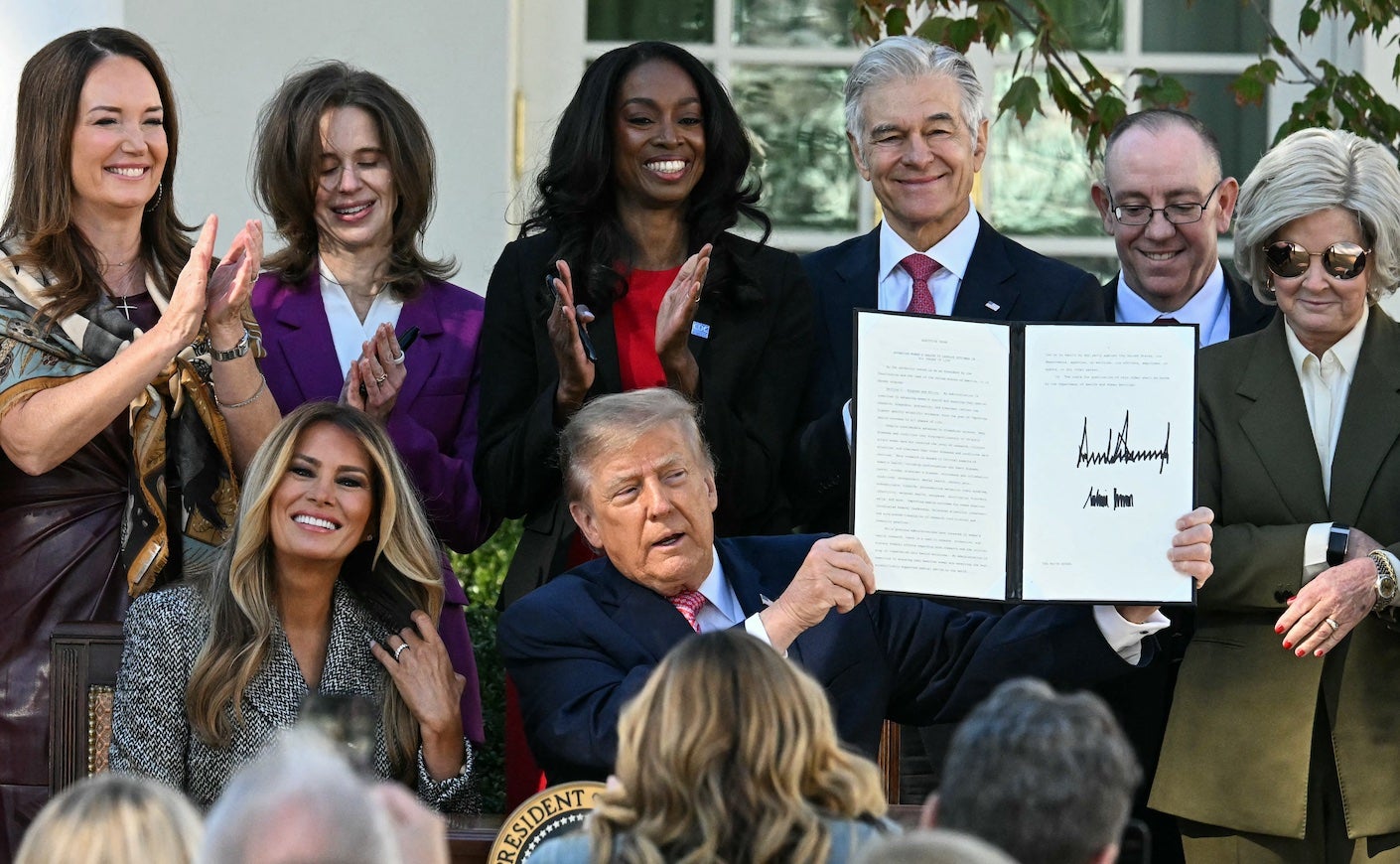
On Monday, the first lady took center stage alongside President Donald Trump in the White House Rose Garden as he signed an executive order she championed. It will create a new women’s health division at the National Institutes of Health and a White House task force focused on conditions ranging from menopause and endometriosis to heart disease and Alzheimer’s.
Many of those same priorities were at the heart of Dr. Jill Biden’s own work on women’s health during her time in the White House. Her initiative called for more research — and more federal funding — into conditions that have historically been understudied.
Now, Trump is replacing that Biden-era framework with his own, even after his administration moved to cut federal biomedical research spending. Unlike Biden’s effort, Trump’s new order doesn’t include a specific funding commitment.
So what happened to Biden’s initiative — and how different is its replacement? Here’s what to know.
What’s in Melania Trump’s new women’s health initiative?
Trump’s executive order gives his administration 90 days to establish the new NIH division.

It will focus on conditions that uniquely or disproportionately affect women and will work alongside the existing NIH Office of Research on Women’s Health, which has operated since 1990. It will also work to increase the inclusion of women and girls in clinical trials (a shocking disparity we've reported on before), encourage new research technologies and personalized medicine, and make sure federally funded research takes biological sex into account.
In addition, a White House Women’s Health Task Force will be led by Health Secretary Robert F. Kennedy Jr. and White House Chief of Staff Susie Wiles. The task force held its first meeting immediately after the event.
Meanwhile, Melania laid out five broader goals for the initiative. Along with directing more research toward women’s health, the administration wants to use artificial intelligence to speed up medical discoveries, accelerate the development of new treatments, and make those breakthroughs more affordable and accessible. The fifth calls for more open conversations about women’s health and issues long overlooked or treated as taboo. (Our own Katie Couric will tackle many of these issues in her upcoming documentary, HORMONAL!)
“This is a transformative moment for women in America,” the first lady said in her remarks. “Beginning today, we will change the reality of women’s health.”
There is one big thing the order doesn’t do: commit any specific new funding to the effort. Its implementation is instead subject to whatever Congress makes available, and it’s not yet clear whether the initiative will bring additional money to the NIH. That uncertainty comes after a turbulent year at the agency, marked by significant staffing cuts and a crackdown on research the administration considered related to DEI. Over that same period, NIH funded 31 percent fewer competitive research projects that mentioned “women” than the year before. And because it already has an office dedicated to women’s health research, it remains to be seen how the new division will differ from — or expand upon — the work the agency is already doing.
The president seemed unaware of the existing NIH office’s existence. “When I heard about it, I said, ‘Are you sure they don’t have that? Who the hell wouldn’t have a women’s health division?’ Melania said, ‘They don’t have it,'" he recalled.
What happened to Jill Biden’s women’s health effort?
If some of this sounds familiar, there's a good reason: The federal government was already tackling many of these same issues under the Biden administration.
Jill Biden made women’s health research one of her signature issues as first lady, helping spearhead the White House Initiative on Women’s Health Research, which President Biden formally established in November 2023.
The initiative was created to address many of the same gaps the Trump administration is talking about now, including a lack of research into conditions like heart disease, Alzheimer’s, autoimmune disorders, endometriosis, and fibroids. Biden followed it with an executive order in March 2024, directing federal agencies to prioritize women’s health research and help translate those findings into better prevention, diagnosis, and treatment.
His administration also backed the effort with significant funding. Biden called on Congress for $12 billion in new women’s health research funding — a request that was never fully enacted — while his administration said the initiative helped generate nearly $1 billion in federal investments through existing programs and funding.
Now Trump has formally ended the Biden-era framework. His new executive order revokes both Biden’s 2024 order and the 2023 memorandum that created the White House initiative, replacing them with his administration’s new NIH division and White House task force.
At least one person who led the Biden effort sees the renewed attention to the issue as a positive development.
“It’s good to see growing bipartisan recognition of the importance of women’s health research and innovation,” Carolyn M. Mazure, Ph.D., who chaired the Biden-era initiative from 2023 to 2025, tells Katie Couric Media. “I was proud to work with Dr. Jill Biden on the first-ever White House Initiative on Women’s Health Research, and we need continued engagement from the public and private sectors to build on that progress.”
Why now?
The move comes as the president and his party face eroding support among female voters ahead of the midterm elections.
Trump’s overall approval rating stands at 33 percent, but it drops to just 30 percent among women, according to a Washington Post-ABC News-Ipsos poll conducted this month. Women are also six percentage points more likely than men to say they strongly disapprove of the president. And perhaps more concerning for Republicans heading into November: 61 percent of women say they’d rather see Democrats control Congress.
That erosion extends to a group that helped Trump return to the White House in 2024: White women. Trump won a majority of their votes in that election, but his approval now stands at 45 percent among White women without college degrees and just 29 percent among those with degrees, according to the Post.
It’s a familiar challenge for Republicans. Female voters helped propel Democrats to sweeping gains in the 2018 midterms, when backlash against Trump contributed to Republicans losing control.
The new push also comes against a complicated backdrop of the administration’s record on women’s health. The FDA has launched a safety review of the abortion pill mifepristone that could lead to new restrictions, while HHS has moved to tie federal family planning grants to some of Trump’s policy priorities. At the same time, the administration has taken steps aimed at expanding treatment options for women, including removing several risk statements from the boxed warnings of six menopause hormone therapies and assembling research and potential development of testosterone treatments for menopausal women.
That doesn’t necessarily mean the new women’s health push is politically motivated. But rolling it out this close to Election Day inevitably puts a spotlight on the announcement, especially when women could play a decisive role in determining which party controls Congress.
