






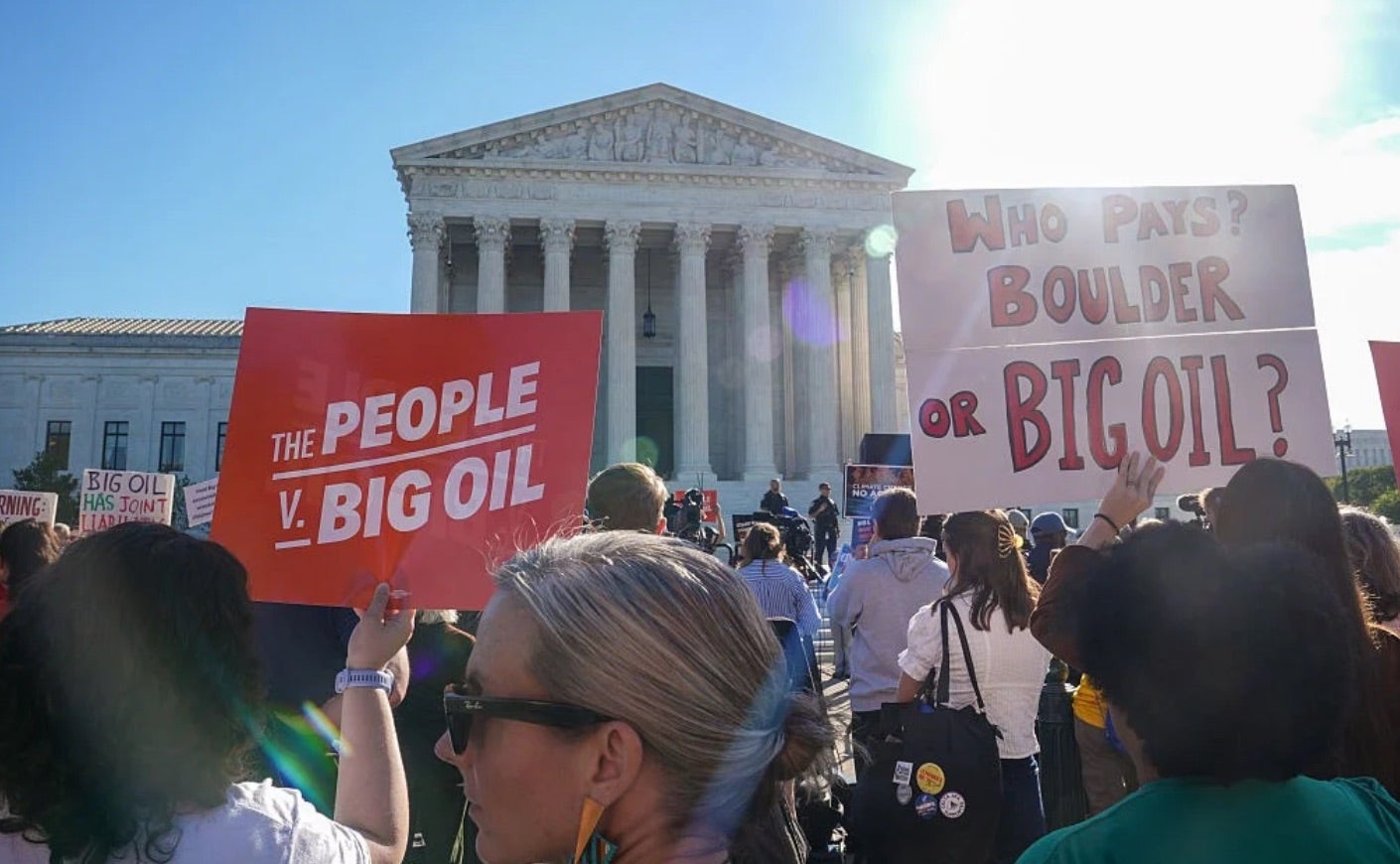
- High stakes climate case over whether cities can make oil companies pay for climate change costs, with uncertain and far reaching consequences.
- Religious preschools' right to public funding while excluding children from LGBTQ families will test First Amendment and nondiscrimination rules.
- Challenge to Cook County assault weapons ban could redefine Second Amendment protections for semiautomatic rifles nationwide.
- Two immigration cases question deporting people to third countries and mandatory detention without bond, affecting thousands' due process rights.
The Supreme Court is back in session — and the justices are taking on some of the country’s biggest legal and political fights.
The court’s new term kicked off Oct. 5 with a major climate case, and the months ahead will bring consequential battles over guns, immigration, religious freedom, and LGBTQ rights. Among the questions before the justices: Can governments ban AR-15-style rifles? Can religious schools receive public money while excluding children from LGBTQ families? And how far can the Trump administration go in detaining and deporting immigrants?
Here are six of the biggest cases we’re watching this term — and what’s at stake in each.
Suncor Energy Inc. v. County Commissioners of Boulder County
At the heart of this case is a big question: Can cities use state law to try to make oil companies pay for the costs of climate change? The justices heard arguments on Oct. 5.
Boulder County and the city of Boulder, Colorado, sued Suncor and Exxon Mobil in 2018, accusing the oil companies of contributing to climate change and misleading the public about the risks of fossil fuels. Boulder is seeking unspecified monetary damages to help cover the mounting costs of dealing with climate change.
After hearing arguments, the justices appeared torn over which side should prevail, with members of the court pressing both sides about the potentially far-reaching consequences of their positions. That leaves the outcome uncertain — and potentially consequential for similar climate lawsuits around the country.

Justice Samuel Alito sat this one out, recusing himself without giving a reason. The move comes amid questions about his oil industry investments. While Alito doesn’t own stock in the companies involved, financial disclosures show holdings in ConocoPhillips and Phillips 66.
St. Mary's Catholic Parish v. Roy
Can religious preschools receive public funding while turning away children from LGBTQ families? The justices will take up that question on Nov. 3.
Colorado’s universal preschool program helps families pay for participating public and private schools, including religious ones. But schools must agree not to discriminate based on sexual orientation, gender identity, and other protected characteristics.
Two Catholic preschools, the Archdiocese of Denver, and Catholic parents argue that denying the schools public funding because they won’t enroll children of same-sex couples violates their First Amendment right to religious freedom. Colorado says religious schools can participate in Colorado’s Universal Preschool Program to receive state funding, but must follow the same nondiscrimination rules as everyone else.
A federal appeals court has already sided with Colorado. Now, the Supreme Court will decide whether the state can require those protections in exchange for public funding.
Viramontes v. Cook County
This case touches on one of the country’s most contentious debates: Can the government ban AR-15-style rifles?
On Dec. 2, the Supreme Court will hear a challenge to a Cook County, Illinois, law prohibiting the possession, sale, and transfer of certain assault weapons, including AR-15- and AK-47-style rifles.
Cook County residents Cutberto Viramontes and Christopher Khaya, along with the Second Amendment Foundation and the Firearms Policy Coalition, sued after the two men were barred from acquiring the rifles for self-defense and other lawful purposes.
The justices must now decide whether the Second and 14th Amendments protect the right to possess semiautomatic rifles.
But the case could have implications well beyond Cook County. It could give the Supreme Court a chance to spell out more clearly just how far Second Amendment protections extend — something the justices have only relatively recently started to do. In fact, the court remained “largely silent on the scope and meaning of the Second Amendment” for more than 200 years, according to the Congressional Research Service.
Department of Homeland Security v. D.V.D.
The Trump administration has already moved to curb immigration, but how far can it go?
The Supreme Court will hear Department of Homeland Security v. D.V.D. during its December argument session, in a challenge to the administration’s policy of deporting people with final removal orders to “third countries” — places that weren’t identified as destinations during their immigration proceedings, where they may have no ties and could face persecution or torture.
The people challenging the policy, represented by groups including Human Rights First, the National Immigration Litigation Alliance, and the Northwest Immigrant Rights Project, say they should get advance notice and a chance to seek protection before being sent elsewhere. They argue that deporting them without those safeguards violates federal law and their right to due process.
Thousands of immigrants are already caught up in the policy. According to the nonprofit Mobile Pathways, more than 13,000 people awaiting asylum rulings have received orders to leave for other countries, where most have no ties.
Republican National Committee v. Mi Familia Vota
A major voting-rights fight heads to the Supreme Court on Dec. 8, when the justices will consider how far Arizona can go in requiring people registering to vote to prove their citizenship.
The case stems from two Republican-backed laws passed in 2022. One requires people using Arizona’s state registration form to provide documentary proof of citizenship, such as a birth certificate or passport. The other requires officials to regularly check voter rolls for potential noncitizens and cancel registrations if citizenship can’t be confirmed.
Voting-rights groups sued, arguing the requirements could keep eligible voters from registering or staying on the rolls. (It's worth noting that federal law already requires people to confirm they’re U.S. citizens when registering to vote — they just generally don’t have to show proof.) A federal appeals court blocked key parts of the laws, and Republicans appealed to the Supreme Court.
The dispute comes amid a broader push from the Trump administration and GOP lawmakers for stricter citizenship checks. The SAVE America Act, which would require proof of citizenship to register for federal elections, passed the House but stalled in the Senate.
The ruling could have implications well beyond Arizona, helping determine how much freedom states have to impose their own proof-of-citizenship requirements.
Rhoney v. Barbosa da Cunha
The court will also decide whether federal immigration law allows the Trump administration to detain certain immigrants without bond hearings. The Supreme Court agreed to take up the case just before the term began on Oct. 1, but oral arguments have not yet been scheduled.
Adopted in July 2025, the policy applies to people who entered the U.S. without inspection, even decades ago. The administration says federal law requires them to stay detained while fighting deportation, reversing nearly 30 years of government practice.
Ricardo Aparecido Barbosa da Cunha, a Brazilian man who has lived here for more than 20 years, challenged the policy after immigration officers arrested him on his drive to work in September 2025. A married father of two and owner of a construction business, he has been awaiting an asylum decision since 2016. He was initially denied a bond hearing, but won one in court and was released after a judge found he wasn’t dangerous or a flight risk.
The Second Circuit sided with Barbosa da Cunha, ruling that immigrants like him who have been living in the U.S. aren’t subject to mandatory detention and can instead seek release on bond. The justices will now decide whether that interpretation of federal immigration law is the right one.
