




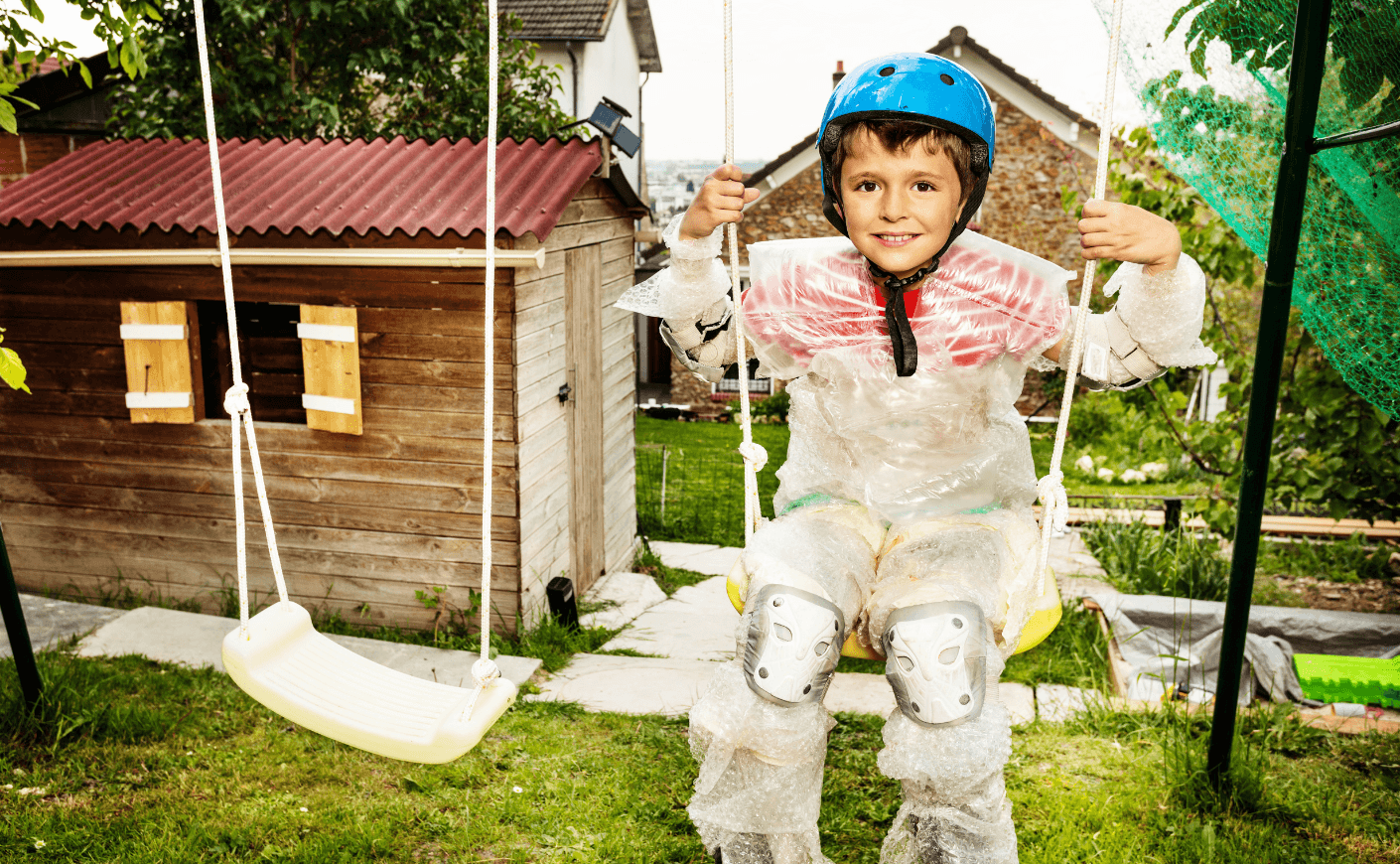
It's time for kids to head back to school, so I’ve recently been pondering the experience of parenting. As I reflect on my journey through fatherhood and my son’s beginning of that adventure (yes, I’m a grandparent!), I find myself wondering about how we prepare kids for a world that feels increasingly complicated, how we prepare them to be functioning adults, and how much oversight they truly need.
Today’s kids are going to face a world we can only imagine — one in which AI will shape their education, entertainment, and careers. The virtual world increasingly will be as real to them as the real world. The future seems as foreign and unpredictable as the Internet and social media were in the 1990s, and television was in the 1950s. Every technological and societal shift brings new challenges.
Five-year-olds today are simply exploring the world, experiencing new things daily, and learning day-by-day how to cope with the problems, relationships, and risks they encounter with friends, in school, and in the wider world. How we help them navigate childhood and develop coping mechanisms and resilience will serve them well in their adult lives.
Every generation grows up with its own challenges: depression, war, and economic turmoil among them. And every kid is born into the randomness of a family, household, or neighborhood that can make life easier or harder. But each generation has unique challenges, and parents must be attuned to them.
How do we confront this world with our children? We live in a world where, as Jonathan Haidt points out, we over-parent children in the real world and under-parent children in the virtual world. The thesis, set forth in some detail in his books, including The Anxious Generation, is that kids are monitored too much in their physical play and freedoms, where children should be allowed to take appropriate risks and do things independently, while we pay precious little attention to what they might encounter on the Internet. Haidt ties this risk aversion and obsessive control to the current spate of mental illness. For more insights into Jonathan’s thesis, I highly recommend watching Katie’s interview with him:
When most of us were in our formative years, bullying amounted to fights on the playground or behind the gym. Today, bullying is more cruel and complex, experienced in dark alleys and online. And while young boys tried to steal a look at Playboy while at the barber shop, today’s youth can access any amount of sexual material, some quite out of the norm, in the comfort of their own rooms on a laptop. Which should we worry about more?
The real world is a semi-dangerous place and that’s what makes minor risk-taking so intriguing for kids, especially in the media they consume. This isn't a new phenomenon. Both the stories of Hans Christian Andersen and Grimm’s Fairy Tales are frightening and, while there isn’t always a Disney-esque happy ending, there is always a message — and a warning. And sure, the Tin Man could sing and dance up a storm, but it was those flying monkeys that brought us back to The Wizard of Oz time after time. Kids confront ogres in fairy tales: better to prepare for when they encounter real-life monsters.
Confronting relatively minor challenges as a child, both in media and in real life, help in navigating larger problems later on. Developing the ability to confront challenge and risk is part of the maturing process. These days, kids aren’t allowed to climb trees, for fear of falling, or go to the local strip mall, for fear of danger — or get on their bike to visit a friend’s house, for fear of injury. Even when accompanied by their parents, kids generally aren't free to wander the aisles of a store, for fear of abduction (which, as has been proven, is statistically extremely rare).

What's remarkable in all of this is that, for all the fears parents have of their kids being led astray in the real world, they're allowed to run amok on the Internet, where they can learn how to make weapons in their basement, interact with faceless predators, cult members, and racists, and learn all manner of sexual extremism. In the meantime, the overlords of the Internet are well aware of the unique dangers posed to young people by social media and their unfettered access to the darkest corners of the Web. And while the giants of social media profess caring, they do little to throttle its dangers (even encouraging it) and spend millions on lobbyists to ensure that even the most reasonable child-protective measures are thwarted.
Those of us of “a certain age” recall the monkey bars in school playgrounds, with metal cross-bars that on a sunny day could approach the temperature of a waffle iron. We recall those squeaky, rusty merry-go-rounds, which we would spin with greater and greater speed, the objective seemingly being to demonstrate centrifugal force to the kids flying out onto the dirt. We climbed trees and jumped down, learning to roll to reduce the impact of the fall. We rode our bikes everywhere. An early memory of mine is of a park near where I grew up: At some point, the city acquired an old military plane that it installed there. This dilapidated, rusting old flying machine, with controls long ago broken off, was a huge hit with the kids. We could climb around the plane, jockeying to occupy the cockpit for a brief moment, imagining ourselves World War II fighter pilots. Sadly, the real plane apparently was judged too dangerous and was replaced by a concrete substitute years later. We all knew better — it went from being an exotic vehicle of flight to just another concrete structure. It was never quite the same…
The takeaway here is that, when we were young, we were given latitude to be kids and make mistakes, sometimes suffering the indignity of a minor injury in the process.
The downside of playing it too safe
Today, parents seem determined to keep their kids in hermetically sealed bubbles. And we often fret over risks that are highly unlikely to occur.
Barry Glassner does an excellent job describing and providing some metrics for these imaginary dramas in Culture of Fear. The book's subtitle says it all: "Why Americans are Afraid of All the Wrong Things." In it, Glassner argues that we have allowed the perception of danger to overshadow the actual risks. The more we restrict children’s natural playfulness and appetite for small risks, we make childhood less about experimentation and more about performative behaviors.
Beyond a general trend to “over-parent,” there are several relatively recently imposed impediments to healthy development. One is the concept of “zero tolerance.” It suggests that there are certain things that, regardless of the circumstance or the humor of the act, require suspension — or even expulsion — from school. There are several terrible lessons resulting from such a policy. First, because the punishment is so great, kids are less likely to “come clean” and admit their failings. After all, the punishment often does not fit the crime — better to cover it up.
Another terrible message is that rules are rigid and inviolable, even when they might make little sense. While there are certainly rules that govern against truly bad behaviors, some are overbroad and offer little latitude. We should be teaching kids that life isn't about rigidity; it's about flexibility. It's about the ability to make rational decisions, rather than singular adherence to nonsensical rules. It's about situational awareness. Many of the idiotic things my friends and I did in junior high or high school would have landed us in suspension — or created an arrest record. In at least one instance, a police officer, who was wise enough to realize that we were teenaged knuckleheads, cut us some slack. I doubt that would occur today (or if it ever occurred, if the kids involved were Black). Zero tolerance is a bad idea that offers little leeway for understanding or empathy.
Another impediment to healthy development is the unwillingness of parents to just let their kids go — for the parents taking a risk by allowing their kids to take risks. But that’s part of the job. Interactions not only with other children, but with educators as well, are intermediated by parents insinuating themselves where they don’t belong. Often, when a teacher criticizes or punishes a child’s behavior, the parents are quick to demand a meeting with the administration to complain about the teacher. Because of parental interventions, kids often aren’t subjected to reasonable consequences for unreasonable behaviors. When a kid makes a mistake, they should learn from it — but rarely in the “zero tolerance” way.
Arguably the most important lesson of growing up is that one’s destiny is in large measure in one’s own hands. How often have we heard the admonition to a child to “Make good choices”? Those choices start on playgrounds and on playdates, evolving to school dances, driving a car, and exercising the privileges of citizenship. The fear of being “empty nesters” sometimes betrays a deeper anxiety — that the child isn't ready to fly from the nest. If so, making those good choices in the future, when the stakes are higher, will be more difficult than it needed to be.
Wisdom of the ages
Sometimes the best instructions for life can be found in the writings of our ancestors. The Talmud, the collected wisdom of Jewish sages, directs that parents are required to instruct their children in several areas: learning the Torah, finding a spouse, learning a trade, and learning how to swim. The first admonition — to learn that we live in a rules-based society — helps teach right from wrong and the importance of fitting into society. The second is, to my mind, a key to happiness — finding a mate but, in a larger sense, finding good friends and worthy colleagues. The third is, of course, of great importance. One must not only grow up intellectually and emotionally, but be a valuable contributor to the common good through the dignity of work. A job and a purpose are important to living a satisfying life.
That last instruction — to teach your child to swim — might seem odd in this list of essential practical advice. Yet, it perhaps is the most important of them all. Swimming is a self-directed activity and a skill that can come in handy, particularly when one falls into water. But the metaphor of this Talmudic admonition is something greater: Teach your children to swim, so that they can save themselves and take care of themselves. So that they can be fully functioning, independent adults, ready to leave the nest and fly.
If the choice is sink or swim, it's better learn how to swim while under the watchful eyes of parents, than be thrown into the water without preparation. But at some point, each of us must face the turbulent waters of life on our own. Along the way, kids have to be protected from real dangers — but they also must be allowed to test the waves before jumping in.