






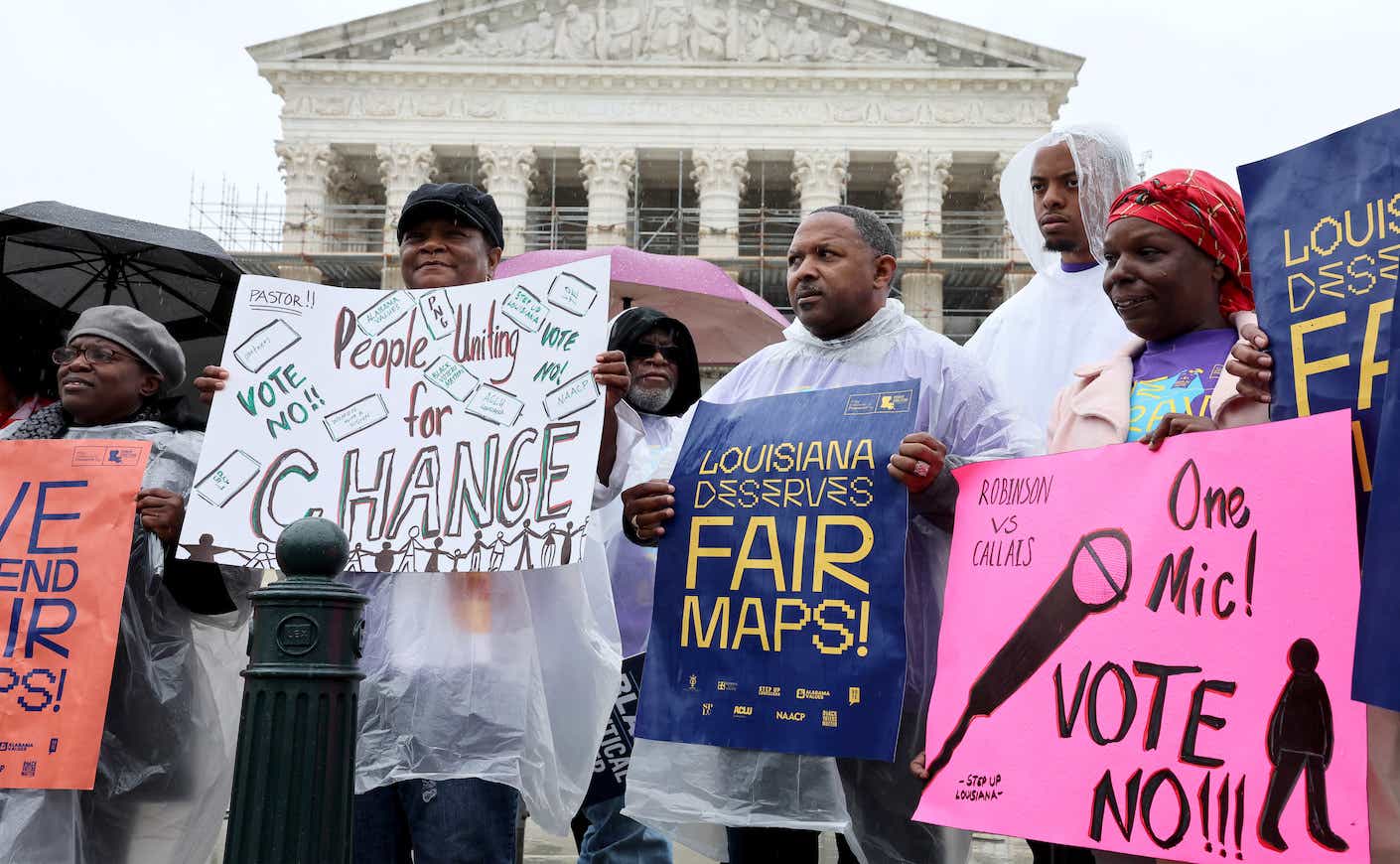
The Supreme Court’s decision to strike down Louisiana’s congressional map is already rippling far beyond the state, setting off a scramble among Republicans to redraw district lines ahead of upcoming elections.
In Louisiana v. Callais, the Court’s conservative majority invalidated the state’s newly drawn second majority-Black congressional district, calling it an unconstitutional racial gerrymander. The ruling stops short of eliminating Section 2 of the Voting Rights Act, but makes these cases harder to bring, requiring clearer proof of intentional discrimination when challenging maps that dilute minority voting power.
Some redistricting experts warn states could respond by eliminating minority opportunity districts — seats where minority voters have a strong chance to elect candidates of their choice. David Froomkin, an assistant professor of law at the University of Houston, told us that the ruling’s implications are “absolutely seismic.” While it’s likely too late to affect the 2026 midterms, he warned it could return the country “to a pre–Voting Rights Act world in which minority voters across the South are deprived of meaningful political representation.”
How quickly states can act on the ruling and move to redraw maps is less clear. With filing deadlines looming and primaries already underway in some states, the window for immediate changes may be narrow. Even so, officials in GOP-controlled legislatures are already moving to test the limits of the decision.
Here’s a closer look at which states are moving the fastest.
Louisiana
Louisiana Gov. Jeff Landry moved quickly after the ruling, issuing an executive order to postpone the state’s House primary. “Allowing elections to proceed under an unconstitutional map would undermine the integrity of our system and violate the rights of our voters,” he said in a statement.

Early voting had been set to begin Saturday ahead of Louisiana’s May 16 primaries. Instead, the order pushes the congressional primary to July 15 or another date the Legislature may set. Republican leaders in both chambers say they’re prepared to pass new congressional maps and reset the election calendar before the session wraps next month.
The move quickly drew national attention. In a series of posts on Thursday, President Trump voiced support for Landry’s plan, while Democrats blasted it. “What they’re effectively doing is changing the rules of the game in the middle of the game,” said Democratic state Sen. Royce Duplessis. “It’s rigging the system.”
Florida
Within hours of the ruling, Florida’s GOP-controlled legislature moved quickly to advance a new congressional map.
The proposal, backed by Gov. Ron DeSantis, had been in the works for months. Anticipating the decision, DeSantis used it to justify redrawing the state’s district lines. “Called this one months ago,” he posted on X shortly after the ruling.
The stakes are significant: the new map would eliminate four Democratic-held seats — one in the Tampa area, one in Orlando, and two in the Fort Lauderdale area — effectively cutting Democratic-leaning districts in half. Florida currently has a 20-8 Republican edge in its congressional delegation; under the proposal, that could expand to a 24-4 GOP advantage.
But the timeline leaves little room to maneuver. With Florida’s August 18 primary approaching and filing deadlines fast approaching, any effort to roll out a new map would face logistical hurdles — and likely immediate legal challenges. Florida’s constitution prohibits maps drawn with explicit partisan intent, and Democratic Chair Nikki Fried has already signaled a lawsuit.
Mississippi
In Mississippi, the ruling is reopening fights that were already underway.
In the days leading up to the decision, Gov. Tate Reeves signaled he was ready to act, announcing plans to call a special session 21 days after the ruling to consider new voting maps.
Though the state already held its primary in March and its runoffs earlier this month, the ruling is reopening legal fights that had been on hold. The state’s proposed maps for its three Supreme Court districts — paused in the Fifth Circuit pending the Louisiana decision — are now back in play.
On Wednesday, Reeves said lawmakers can “use their constitutionally recognized right to draw these” judicial districts. Still, like Louisiana, Mississippi had been defending its maps after a U.S. District Court found they likely violated the Voting Rights Act by diluting Black voters’ ability to elect candidates of their choice. Lawmakers adjourned earlier this year without acting on the judicial maps.
With a special session on the horizon, Democrats are bracing for what’s ahead. “The first chance our leadership gets to start testing the boundaries of Black voting power, they take it — they don’t even pretend otherwise,” Cheikh Taylor told The New York Times.
Tennessee
Tennessee Republicans are going further, openly calling for new maps ahead of the state’s Aug. 6 primary.
In a post on X, Sen. Marsha Blackburn urged state lawmakers to redraw congressional lines to add another GOP seat, specifically targeting the Memphis-based district. Blackburn, a leading contender in the state’s next gubernatorial race, promised she would “do everything I can to make this map a reality.”
The push appears to have backing at the national level. Trump said Thursday he spoke with Gov. Bill Lee about redistricting, writing on Truth Social that Lee “would work hard to correct the unconstitutional flaw” in the state’s current map.
Republicans already hold eight of Tennessee’s nine House seats, but the proposal would take aim at the lone Democratic district in Memphis, represented by Steve Cohen, who won reelection in 2024 with 71 percent of the vote.
Georgia
Elsewhere in the South, the response has been more cautious. In Georgia, calls to redraw congressional maps are gaining traction, but whether anything actually changes is far from certain.
Several high-profile Republicans, including GOP gubernatorial contenders Burt Jones and Rick Jackson, have urged lawmakers to revisit the state’s maps. But only Gov. Brian Kemp has the authority to call a special session — and he’s so far holding back.
“We are actively analyzing this ruling and its potential impacts, but cannot comment further at this time,” his office said.
The backdrop here matters: Georgia was already forced to redraw its maps during a 2023 special session after a federal judge found that existing district lines diluted the voting power of Black residents. Now, the Supreme Court’s ruling could make similar challenges harder to win by requiring proof of intentional discrimination.
Even if Kemp were to act, timing could complicate things. Georgia’s primary is set for May 19, and early voting is already underway under the current district lines — meaning any attempt to redraw maps mid-cycle would likely trigger immediate legal challenges, leaving one of the country’s most closely watched states in limbo.
Other states yet to hold primaries — including South Carolina, Alabama, Maryland, and Missouri — could offer the next test of how far the ruling reaches.
