


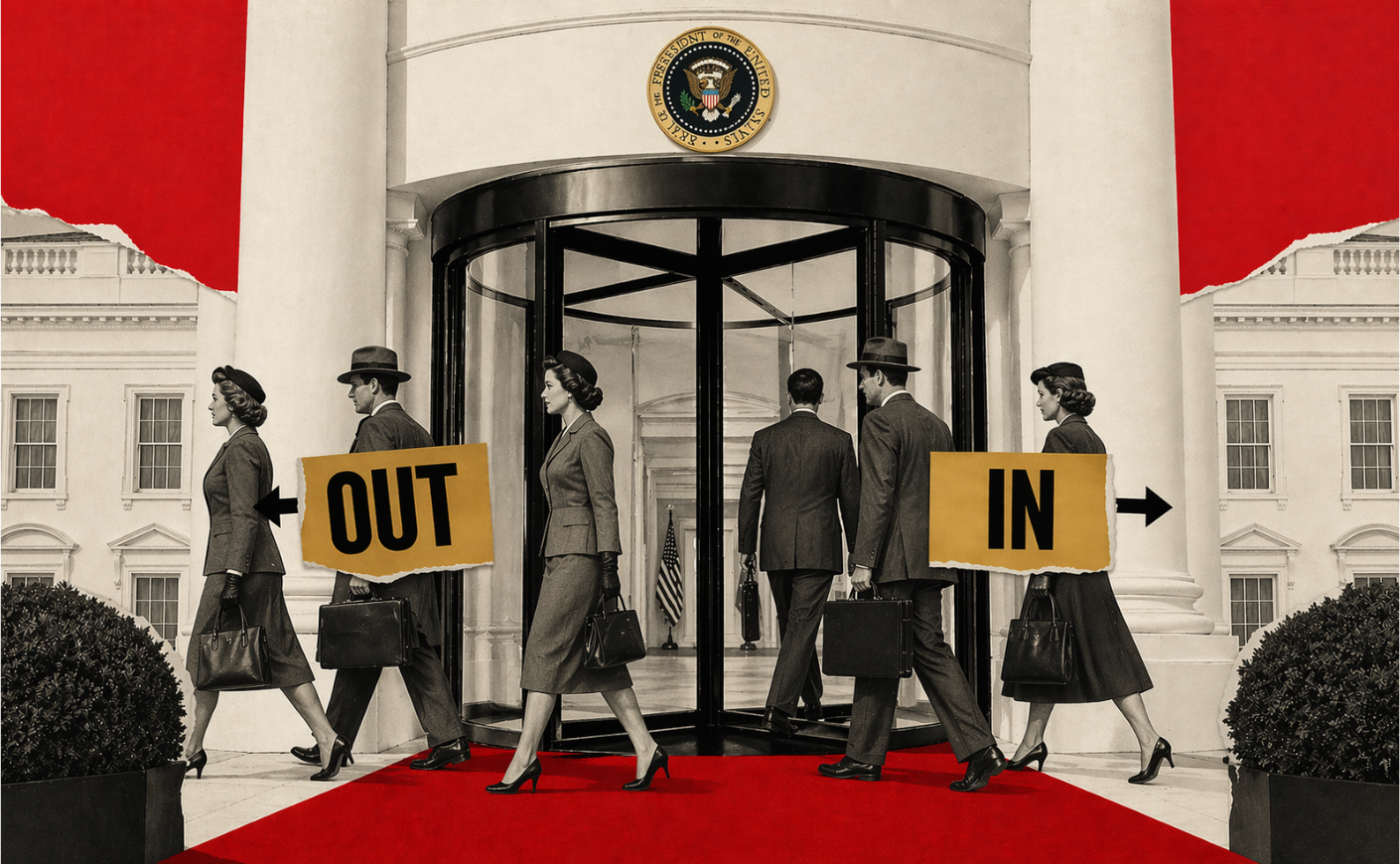
Turnover in Washington isn’t unheard of, but the exits in President Trump’s second term are starting to add up.
Homeland Security Secretary Kristi Noem, Attorney General Pam Bondi, Labor Secretary Lori Chavez-DeRemer, and Director of National Intelligence Tulsi Gabbard all left their posts and were succeeded by men. Now Susie Wiles, the first woman in U.S. history to serve as White House chief of staff, is the latest to follow that pattern.
The exodus marks a striking turn of events for an administration that initially boasted higher female representation, with women making up about 37 percent of the Cabinet — up from roughly 24 percent in Trump’s first term. (And if you’re wondering who’s still there, only three women remain in Cabinet-level posts: Agriculture Secretary Brooke Rollins, Education Secretary Linda McMahon, and Small Business Administration chief Kelly Loeffler.)
Personnel churn is hardly new to Trump. His first term was defined by headline-making firings and what often felt like a revolving door of high-level exits. This time, the turnover has unfolded less like a dramatic shakeup and more like a steady drip.
We took a closer look at some of the officials who’ve left the administration, and why.
Inside the Cabinet
DHS Secretary Kristi Noem
Noem left due to what one administration official described as “a culmination” of missteps.

There was the fallout from a Minnesota operation in which federal agents killed two civilians, a flashpoint that drew bipartisan scrutiny. Then came the questions around a costly ad campaign she oversaw, urging undocumented immigrants to self-deport — a $200 million effort that prominently featured Noem herself. She told lawmakers that Trump had signed off on it, but the White House quickly disputed that claim.
The controversies didn’t stop there: Noem also faced scrutiny over her relationship with longtime Trump ally Corey Lewandowski — allegations both have denied.
White House Press Secretary Karoline Leavitt
Leavitt stepped down as White House press secretary at the end of August, months after giving birth to her second child. Trump announced her departure on Truth Social, saying she was leaving to spend more time with her family.
Leavitt made history in 2025 when she announced she was expecting her second child, becoming the first woman to serve as White House press secretary while pregnant. She gave birth to her daughter, Viviana, in May, took maternity leave, and returned to the briefing room podium in July.
But just weeks after returning, Leavitt said she realized the job's demands were hard to reconcile with being home with her two young children. “I have felt in my heart that I cannot be the best mom my two young children deserve while devoting the constant time, energy, and attention required of the White House Press Secretary,” she wrote on X, calling her departure a “bittersweet decision.”
Leavitt didn't leave Trump’s orbit entirely. Trump said she will now serve as one of his “top outside” advisers and will be “an influential voice within the Republican Party” ahead of the midterms.
Attorney General Pam Bondi
Trump abruptly ousted Bondi in April after reportedly growing frustrated that some of his top priorities weren’t progressing. But the cracks had been showing for months: A federal judge threw out DOJ cases targeting political adversaries like New York Attorney General Letitia James and former FBI Director James Comey, and in February, the department declined to indict six Democratic lawmakers over a video urging the military to refuse unlawful orders, according to NBC News.
There was also growing internal frustration with how Bondi handled the Epstein files. In an interview with Vanity Fair in December, then White House Chief of Staff Susie Wiles said Bondi “completely whiffed” on them. Early on, Bondi hinted that explosive material could still be coming, but the eventual release of heavily redacted files seemed only to undercut that claim.
Still, Trump framed her exit as a transition, saying she’ll move on to a “much-needed and important” role in the private sector.
Labor Secretary Lori Chavez-DeRemer
After weeks of mounting scrutiny — including an investigation into whether she pursued a romantic relationship with a subordinate on her security detail, who was placed on leave in January — Chavez-DeRemer resigned. Her attorney, Nick Oberheiden, told NBC News that the resignation “is not the result of legal wrongdoings,” but a personal decision. White House communications director Steven Cheung said she is expected to take a job in the private sector.
In early March, two of her top aides stepped down amid a “travel fraud” probe tied to personal trips. And in February, The New York Times reported that Chavez-DeRemer’s husband had been barred from Labor Department headquarters after two employees accused him of sexual assault — allegations he has since denied.
White House Chief of Staff Susie Wiles
Two days after Republicans lost control of both chambers of Congress, White House Chief of Staff Susie Wiles submitted her resignation. Axios reported that she and Trump agreed she would step down and that he privately blamed her for the losses. Wiles had expected to stay through Congress’ lame-duck session, but Trump moved up her exit, according to CBS News.
But the president struck a different tone in public. In a Friday post on Truth Social, Trump announced that longtime aide Stephen Miller would take over as chief of staff and that Wiles, who he said had done “an outstanding job,” would move to his political operation. (What she’ll do there is still unclear.) “While my role may be changing, my commitment to the president and the mission never will,” Wiles wrote on X following the announcement.
Wiles’s exit also brought a fresh controversy. Former Trump health adviser Calley Means told podcaster Joe Rogan that Wiles blocked an effort to make kids’ diets healthier because she wanted to keep sugar-industry donations flowing ahead of the midterms. Wiles’s spokesperson, meanwhile, has denied the allegation.
Across federal agencies
CDC Deputy Director and Chief Medical Officer Jennifer Shuford
Jennifer Shuford, the Centers for Disease Control and Prevention’s deputy director and chief medical officer, will step down on Nov. 12, a little more than a week after the midterm elections. Shuford said in a statement that she was leaving to spend more time with her family, but The Washington Post reported that disagreements with the administration over vaccine policy also factored into her decision.
Shuford, an infectious-disease physician and former Texas health commissioner, was hired in April as part of a new four-person leadership team brought in to run the CDC and restore confidence in the agency. But it’s hardly been a quiet few months. Shuford has helped oversee the response to an Ebola outbreak overseas, even as the CDC has faced criticism over the country’s ongoing measles outbreak and a dispute with Pennsylvania over its refusal to acknowledge several deaths tied to the disease.
For now, career public health official Satish Pillai will take over as acting deputy director and chief medical officer while the CDC searches for a permanent replacement.
U.S. Ambassador to Greece Kimberly Guilfoyle
Guilfoyle announced on Oct. 13 that she would be leaving her post after the White House asked her to resign. The decision came just a day after Trump publicly suggested her job was in jeopardy, telling reporters, "We're not happy."
The shake-up follows a series of reports alleging misconduct, including claims that Guilfoyle asked a Trump donor for $100,000 to pay off a credit card bill in exchange for access to administration officials. Guilfoyle has denied any wrongdoing.
In a lengthy statement posted on X, she called serving as ambassador the "honor of a lifetime" and vowed to defend herself against the allegations. "While my time as Ambassador may be coming to an end, my commitment to President Trump, the America First movement, and the country I love will never end," she wrote.
CDC Director Susan Monarez
After less than a month on the job, Monarez was ousted as director of the Centers for Disease Control and Prevention in August 2025. The Department of Health and Human Services announced her departure on social media, offering no explanation.
Her lawyers later pushed back, saying Monarez had been targeted for “protecting the public over serving a political agenda” and casting her removal as part of a broader “dangerous politicization of science.”
Her exit didn’t happen in isolation, though: It came alongside a wave of high-level departures at the Centers for Disease Control and Prevention, including deputy director Debra Houry, Daniel Jernigan, who led the agency’s National Center for Emerging and Zoonotic Infectious Diseases, and Demetre Daskalakis, who headed the National Center for Immunization and Respiratory Diseases.
Navy Secretary John Phelan
Navy Secretary John Phelan’s departure has raised questions about what prompted his exit — and the Pentagon hasn’t offered many answers.
Pentagon spokesman Sean Parnell thanked Phelan for his service but offered no details about why he stepped down or whether the decision was his. An administration official later told The Hill that Phelan had been asked to resign.
Phelan, a billionaire art collector and longtime Trump donor, had pushed an ambitious “Golden Fleet” plan to expand the Navy, including a proposed “Trump-class” battleship. But his tenure was also marked by reported internal clashes, including tensions with Defense Secretary Pete Hegseth and Deputy Defense Secretary Stephen Feinberg.
Hung Cao has since stepped in as acting Navy secretary. While Phelan wasn’t directly overseeing military operations, his role put him in charge of the Navy’s broader readiness, shipbuilding, weapons procurement, and supply pipeline. That makes the leadership change significant well beyond the Pentagon’s personnel shuffle.
ICE acting director Todd Lyons
Todd Lyons stepped down as head of Immigration and Customs Enforcement at the end of May, after announcing his resignation earlier that month. In a letter to Homeland Security Secretary Markwayne Mullin, Lyons called it a “tremendous honor” to lead ICE and said he was leaving to “spend more time with my family.”
But his departure came amid broader scrutiny of the agency and its role in Trump’s immigration crackdown. ICE has faced backlash over its aggressive enforcement tactics, while polling has shown Americans divided over the administration’s approach. In a January New York Times/Siena University poll, about half of voters supported Trump’s deportation push, while 47 percent said ICE had gone too far.
Medicaid director Drew Snyder
Drew Snyder, former deputy administrator at the Centers for Medicare & Medicaid Services and director of the Center for Medicaid and CHIP Services, resigned last June — and the reason was never fully explained. A source close to the situation told Politico that it wasn’t tied to politics or agency shake-ups, pointing instead to an unspecified “personal family matter.”
Before stepping down, Snyder had played a central role in shaping Medicaid policy. According to his bio at the national law firm Baker Donelson, he “spearheaded regulatory and policy reforms” and helped lead negotiations around Trump’s signature One Big Beautiful Bill Act — legislation that ultimately enacted the largest cuts to Medicaid in the program’s history. The Congressional Budget Office estimates the law will reduce federal Medicaid spending by roughly $1 trillion over the next decade, with more than 10 million people projected to lose coverage by 2034.
National security adviser Mike Waltz
Then-National Security Adviser Mike Waltz found himself at the center of an awkward — and alarming — security lapse last year. He accidentally added The Atlantic editor-in-chief Jeffrey Goldberg to a private Signal group chat discussing classified military plans targeting the Houthis in Yemen, later blaming the confusion on a phone contact mix-up and calling it “embarrassing.”
But despite the fallout from that episode, it doesn’t appear to be what ultimately led to his exit: According to Politico, Waltz’s more hawkish stance on Iran increasingly put him out of step with others in the administration. And in a notable twist, the one-time congressman has since been nominated to serve as U.S. ambassador to the United Nations.
Beyond the administration
Special Government employee Elon Musk
Even some of Trump’s outside allies seemingly severed ties with the leader. Elon Musk, for one, served as a Special Government Employee in an advisory capacity, though that role was always meant to be temporary. These positions are typically capped at 130 days a year, and Musk’s involvement appeared to wind down as he shifted focus back to his companies, including Tesla and SpaceX.
But the end of his tenure also marked the start of a rift. After leaving, Musk’s relationship with Trump grew increasingly tense, with Musk publicly criticizing parts of the administration’s agenda. The president fired back over everything from electric vehicle subsidies to loyalty, turning a minor exit into a much more visible political break.
