






As the U.S. and Israel continue their military campaign against Iran, the goals — and the possible endgame — remain unclear.
The war has already drawn criticism in Washington, particularly from Democrats who have questioned the rationale behind the strikes and warned about the risk of escalation. But skepticism hasn’t been limited to one side of the aisle. While most Republicans have supported the campaign, some conservatives — including GOP Rep. Thomas Massie and commentator Tucker Carlson — have raised concerns about the potential for a wider conflict and whether the strategy is clearly defined.
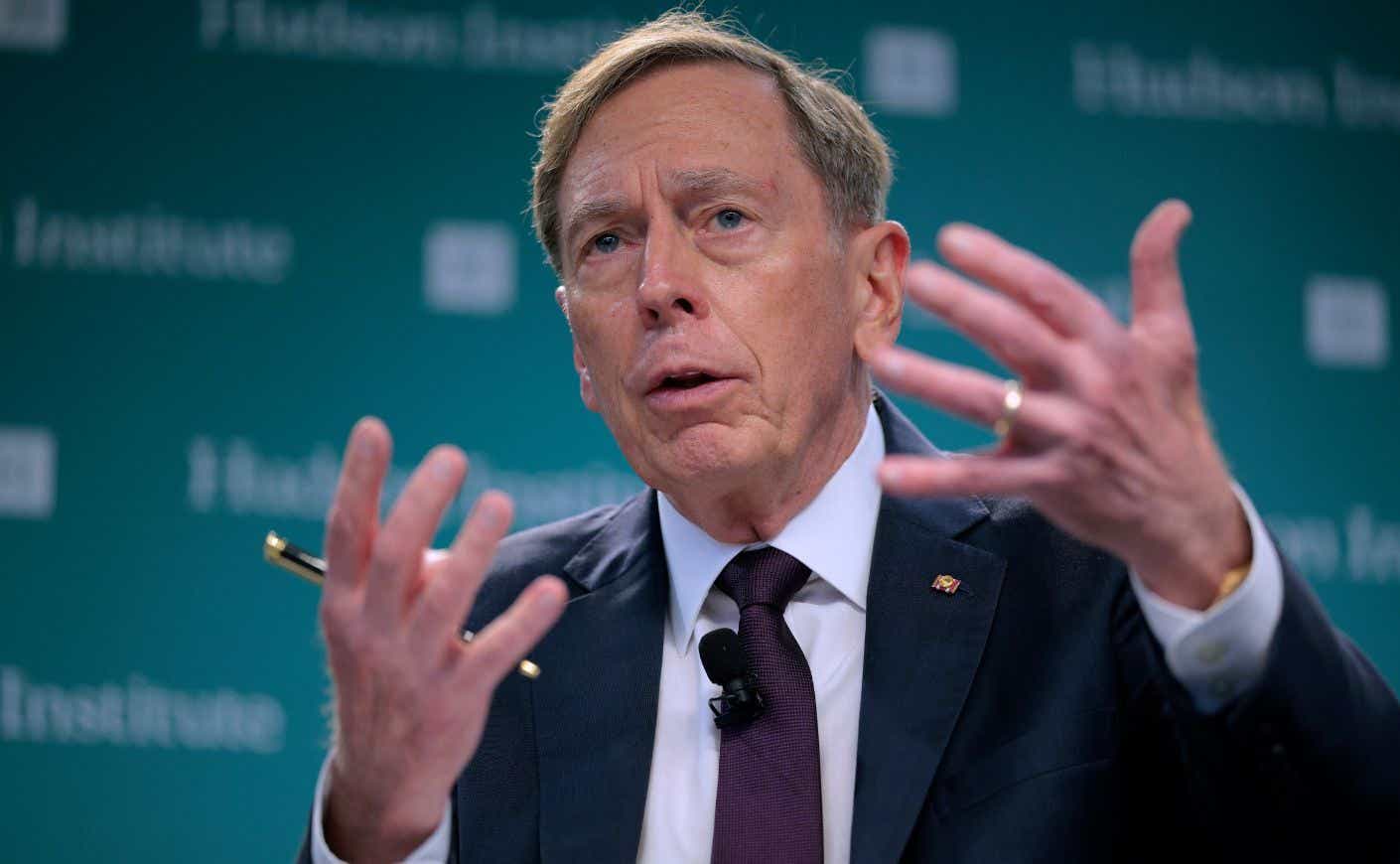
To better understand what might come next, Katie sat down with retired Gen. David Petraeus, the former CIA director and commander of U.S. forces in Iraq and Afghanistan.
Petraeus's takeaway? This campaign is focused less on regime change and more on degrading Iran’s military capabilities — and ultimately forcing Tehran back to the negotiating table.
Here’s a breakdown of some of the most important moments from Katie’s conversation with the top general.
Why did the war start anyway?
Petraeus says the impetus behind the conflict was twofold: growing concern in Israel about Iran’s missile capabilities and mounting frustration in Washington over stalled nuclear negotiations.

First, Israeli officials were increasingly alarmed by how quickly Iran appeared to be rebuilding its missile arsenal after the earlier 12-day conflict between Israel and Iran.
“The Israelis were increasingly concerned about the reconstitution of Iran’s missile program,” Petraeus says, noting that the earlier war had partly ended because “the missile math was starting to get a little bit uncomfortable.” In other words, there were growing concerns about how many missiles Iran still had left — and how many interceptors Israel and its allies had to stop them.
According to Petraeus, Israeli leaders believed Iran was rebuilding those capabilities faster than expected and were already considering a military operation. “They’ve watched this be reconstituted more rapidly than anticipated, and they were going to conduct an operation within another month or two anyway,” he tells Katie, adding that conversations he had in Tel Aviv suggested that was the prevailing view among officials there.
At the same time, Petraeus thinks the Trump administration had grown increasingly frustrated with Iran during nuclear negotiations. “They were feeling like they were getting strung along,” he says.
That frustration coincided with what Petraeus described as “fleeting intelligence” showing the location and movements of Iran’s supreme leader and other senior regime officials — intelligence he believes prompted the administration to move ahead with the operation.
The strikes were unusual in another way: They happened in broad daylight instead of the early morning hours, when operations like this are typically launched.
What the U.S. and Israel are trying to accomplish in Iran
Petraeus says the operation has followed a fairly deliberate sequence of targets. It began with strikes on senior Iranian leadership figures before quickly shifting to Iran’s air and ballistic missile defenses — systems that would normally threaten incoming aircraft.
Neutralizing those systems allows the U.S. and Israel to expand the scope of their air campaign. Once those defenses are degraded, more aircraft — including non-stealth fighters and bombers — can operate with less risk.
From there, the campaign has focused on Iran’s missile launchers and stockpiles, as well as drone programs that have become an increasingly important part of modern warfare.
“After the air and ballistic missile defenses come the focus on the missile launchers,” Petraeus explained, noting that without the latter, missiles can’t be used. “Without them, you can take your time about destroying the missiles because they can’t get them in the air.”
The strategy appears to already be making an impact: According to Petraeus, “the number of missiles launched is down by over 90 percent from early on.”
Still, Petraeus cautioned that the risks of escalation remain. Iran’s drone capabilities, for example, have become a major concern in this age of modern warfare, and Petraeus warned that the country’s broader military apparatus remains significant. “This is a very formidable force,” he says.
Beyond the battlefield, the conflict carries wider risks — from the possibility of regional escalation to economic shocks if fighting disrupts global oil supplies. Petraeus suggests the campaign is aimed at weakening Iran’s capabilities, but it also carries uncertainties that could shape how the conflict evolves.
Why regime change is unlikely
For all the talk about weakening Iran’s leadership, Petraeus cautioned that the current military campaign is unlikely to topple the regime outright.
“We can’t bring about regime change with the kind of campaign we’re embarked on,” he tells Katie. “It would be an extraordinary campaign to do that with forces on the ground.”
President Trump hasn’t ruled out sending in U.S. troops — and according to Petraeus, “nor should he.” He emphasizes that military leaders often avoid taking options off the table during a conflict, at least publicly: “Let them think that we will use every tool in our arsenal — even while being very judicious about how you think about using boots on the ground,” he tells Katie.
Part of the challenge is simply scale. Petraeus notes that Iran has roughly three and a half times the population Iraq had when the United States invaded in 2003. Today, Iran is home to more than 90 million people.
Its military is also substantial, with more than 600,000 active-duty troops and hundreds of thousands of reservists, alongside powerful paramilitary organizations tied to the regime.
Beyond raw numbers, Iran’s security apparatus is designed to withstand outside pressure. The regular military operates alongside the Islamic Revolutionary Guard Corps (IRGC), an ideologically driven force that plays a central role in defending the regime and maintaining internal control.
Geography also works in Iran’s favor. The country spans more than 600,000 square miles of mountainous and difficult terrain, which would make any large-scale ground invasion far more complex than the largely flat battlefields of Iraq.
Taken together — a large population, sizable military forces, entrenched security institutions, and challenging terrain — Petraeus argues that an air campaign alone is unlikely to bring about regime change.
Instead, he suggests the operation is more realistically aimed at weakening Iran’s military capabilities and limiting its ability to threaten Israel or U.S. forces in the region, rather than removing the government itself.
Trump and his administration’s mixed messages
Trump’s messaging on the war has been all over the map. At times he has suggested the conflict could end “soon” because there is “practically nothing left to target,” while also leaving the door open for escalation, saying the U.S. could “go further.”
The Pentagon, meanwhile, has struck a more cautious tone, warning that the campaign may take longer and emphasizing that the operation is aimed at degrading Iran’s military capabilities rather than pursuing regime change.
But Petraeus says that kind of ambiguity may not be accidental. “President Trump has always thought that being unpredictable has some value,” he tells Katie. “There’s always a degree of improvisation with him.”
Ultimately, Petraeus says the end of the conflict may come down to a political decision rather than a purely military one. “I think the way it ends is President Trump decides it’s over,” he says.
At that point, the former general believes the fighting could give way to negotiations over Iran’s nuclear program, but he warned the confrontation may not disappear entirely. “In this case, the guns will fall silent, assuming the Iranians go along with the president’s decision, and then we will return to the negotiating table,” he predicts. “And if they don’t, they’re going to revisit this periodically.”
Whether that strategy ultimately leads to a diplomatic breakthrough — or simply sets the stage for another round of conflict — remains one of the biggest unanswered questions of the war.
