






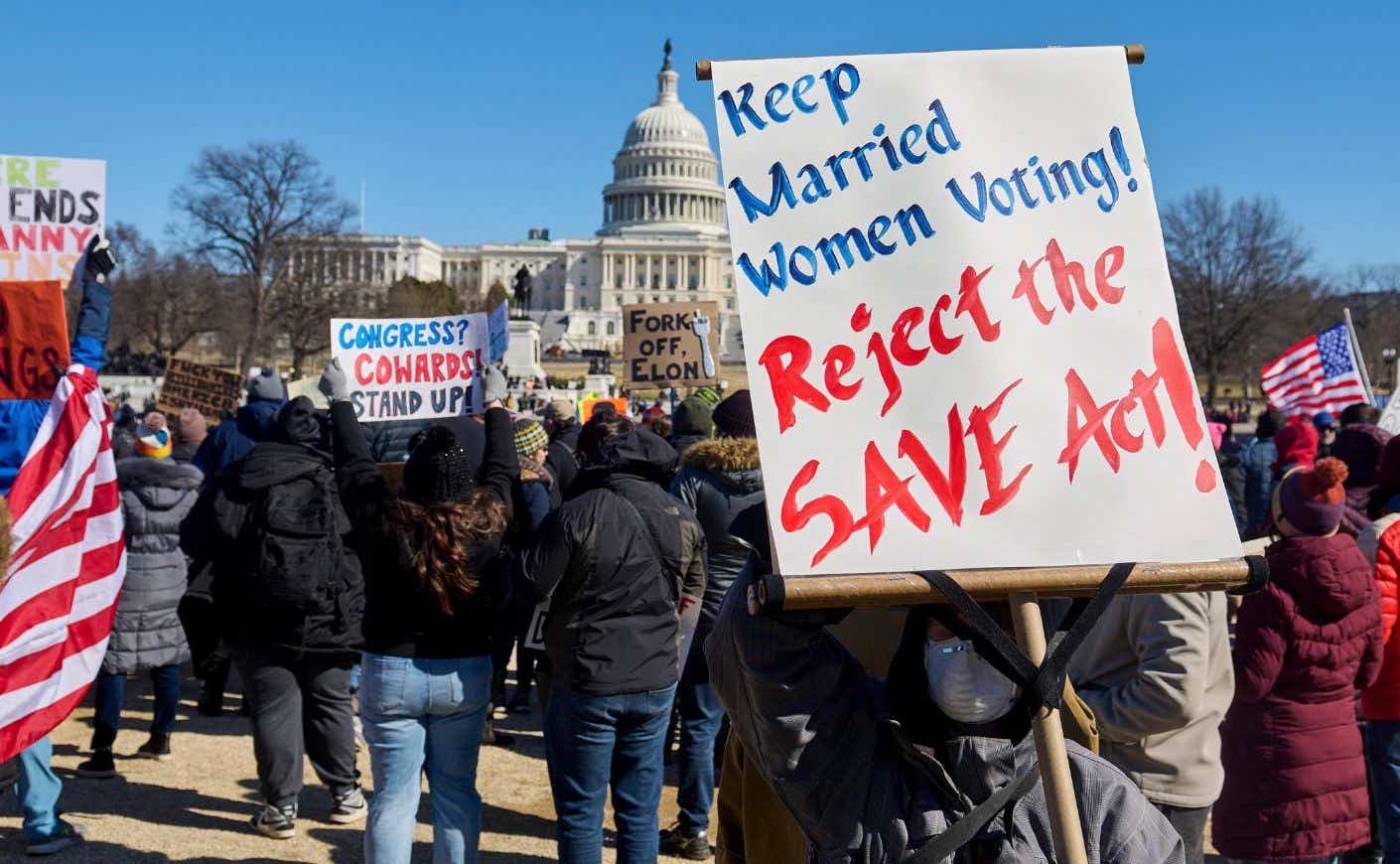
The 2026 midterms are still months away, but the groundwork is already being laid. In Washington, Republicans are advancing the Safeguard American Voter Eligibility Act — known as the SAVE Act — which could reshape how Americans register and prove their citizenship. At the same time, state legislatures and courts are revisiting congressional maps in ways that could reconfigure districts and potentially tilt the balance of power.
These parallel battles — one over access to the ballot, the other over the boundaries that determine how votes translate into seats — are unfolding largely outside the campaign spotlight. Taken together, they could shape turnout, representation, and ultimately control of a narrowly divided House. With margins in recent elections decided by just a handful of seats, even small procedural or geographic shifts could carry outsized consequences.
The status of the SAVE Act
In recent weeks, Trump has made the SAVE Act a focal point of his national agenda, urging lawmakers to pass the legislation as a centerpiece of election-security policy. During his 2026 State of the Union address, the president asked Congress to approve the voter-ID and proof-of-citizenship bill “before anything else,” positioning it as a response to what he described as widespread election fraud — claims disputed by independent election experts.
At its core, the SAVE America Act would change what Americans must show to register for federal elections. The bill would amend the National Voter Registration Act of 1993 to require documentary proof of U.S. citizenship — such as a birth certificate or passport — not only for first-time registration but also when voters update their information after a move or name change. That means documentation would be required before someone could be added to, or make changes to, the federal rolls.
The idea has surfaced before: Versions of the SAVE Act cleared the House in 2024 and 2025 but stalled in the U.S. Senate, where most legislation requires 60 votes to overcome a filibuster. With unified Democratic opposition and not enough Republican support to reach that threshold, Senate leaders never brought the bill to a final vote. The 2026 measure largely follows those earlier efforts, with additional provisions tied to election administration and ballot procedures. Its path forward remains uncertain: Senate Majority Leader John Thune has indicated there aren’t enough Republican votes to change the chamber’s rules, meaning the bill would once again require bipartisan backing in a closely divided Senate.

Some states have experimented with proof-of-citizenship requirements, with mixed results. Kansas enacted one in 2013, but federal courts later blocked it. Arizona has required proof of citizenship for state and local elections since 2004, though it must still allow residents without documentation to vote in federal races under federal law. The SAVE Act would apply a documentary proof requirement nationwide for federal elections — replacing the sworn-attestation system most states currently use and eliminating the federal-only voting option that exists in states like Arizona.
Its path forward is far from certain. Senate Majority Leader John Thune has said there isn’t enough Republican support to change filibuster rules, meaning the bill would need 60 votes to advance — a steep climb in a closely divided chamber. Justin Levitt, a law professor at Loyola Marymount University, writes in an email to Katie Couric Media that he's skeptical it has enough support to succeed, in part because stricter documentation requirements could “affect Republican voters fairly significantly,” making some lawmakers hesitant to risk their own reelection campaigns.
Even if the measure were to pass, its legal footing would depend on how courts evaluate it. “The thing about new legislation is that it resets the standard of what’s legal under existing law,” Levitt says. “If it passed — a big if — I don’t think it would be vulnerable under existing federal statutes. It might well face a constitutional challenge, but timing matters more than anything for 2026.”
Democrats have sharply criticized the measure. Senate Minority Leader Chuck Schumer called it “Jim Crow 2.0,” arguing it echoes past efforts to suppress minority voters. Civil rights groups, including the American Civil Liberties Union, have described it as a “dangerous assault on American democracy.”
Voting in federal elections as a noncitizen is already illegal — and documented cases are rare, with the Heritage Foundation’s database identifying 24 instances between 2003 and 2023. Still, Republicans argue that affidavits alone are insufficient and say stricter documentation standards are needed to prevent fraud and bolster confidence in elections. “We need elections where people aren’t able to cheat,” President Trump told NBC’s Tom Llamas earlier this month.
Opponents counter that the greater risk isn’t fraud — it’s access. Since the bill would require official proof of citizenship, voters couldn’t simply sign an affidavit. Yet many Americans don’t have qualifying documents readily available: roughly half lack a passport, and nearly one in ten eligible adults cannot easily access proof of citizenship. Even when documents exist, mismatched names or outdated information can create complications. For example, a passport might show a maiden name, while a driver’s license shows a married one.
Advocates warn those hurdles could disproportionately affect married women, naturalized citizens, low-income Americans, rural voters, seniors, young people, and transgender Americans. That concern isn’t merely hypothetical: Research suggests even modest registration barriers can shape turnout at the margins — particularly in closely contested races.
Redistricting: the battle over maps
While the SAVE Act is about who gets to vote, redistricting is about how those votes translate into power — and whether they carry more weight in one district than another.
Every 10 years, states redraw congressional maps after the census to reflect population shifts. But in several states, those boundaries are being reconsidered before the decade is over — prompted by court decisions, political recalculations, or both. While mid-decade redistricting is legal, it has historically been rare outside court-ordered fixes, making the current moment especially consequential. With Republicans holding the House by a narrow 218–213 margin, even a handful of revised districts could tip the balance.
“A butterfly flaps its wings somewhere in the country and the composition of the House changes as a result," Levitt writes. That said, indications so far are that this election is shaping up to be something of a wave election, and a wave of a significant size is likely to swamp litigation over registration rules or an individual incremental House seat or two. So ultimately, I’m pretty confident that the outcome of the House is going to come down to national trends rather than incremental litigation."
Unlike states such as California, which rely on independent redistricting commissions, others — including Florida — allow partisan legislatures to draw their own maps, giving the majority party greater sway over the process.
Texas — the first state to move after Trump urged allies to revisit their House maps — could produce as many as five additional GOP-leaning seats in the midterms. On the other side of the country, California could generate a comparable number of Democratic-leaning districts after the Supreme Court upheld its revised plan, rejecting Republican claims that it improperly prioritized Latino voters. The contrast highlights how commission-led systems and legislature-controlled processes can influence the political terrain in markedly different ways.
Elsewhere, several states are weighing mid-cycle revisions. In Florida, Gov. Ron DeSantis has proposed convening a special legislative session in late April to revisit congressional boundaries. Republicans, who already control most of the state’s delegation, are eyeing potential gains of two to four seats in central and South Florida. In Virginia, the Democratic-controlled legislature has approved a constitutional amendment that would allow lawmakers to redraw districts before the midterms. If voters approve the measure in an April 21 referendum, Democrats could net between two and four seats under a proposed plan.
Additional court rulings — including a pending SCOTUS decision that could reshape how the Voting Rights Act applies to redistricting — may further alter the landscape before November. But the legal terrain has already shifted significantly: In 2019, the Court ruled that federal judges cannot police partisan gerrymandering, leaving most disputes to hinge on racial discrimination claims or state constitutional law.
With margins this tight, a small number of competitive seats could determine which party claims the majority. And with major rulings still ahead, some maps may not be fully settled before voters head to the polls. In a year dominated by turnout and messaging, this quieter contest over representation could matter just as much. Whoever prevails will set the legislative agenda, underscoring that the stakes of redistricting extend far beyond Election Day.
