







Randy Webster believes in magic. “I grew up on Lord of the Rings,” says the 65-year-old father of three, “And at some point, I thought, I want to create something like this.” Starting in his teens, Webster began dreaming up The Tarra Tales, a fantasy trilogy where dragons and elves wander the earth and adventure is found around every corner.
Webster’s own life has been full of adventure, too: After a childhood in Colorado and Arkansas, he joined the Peace Corps where he worked as an elementary school teacher in a rural village in Africa. “When I left, my mom told me, ‘Don’t come back until you’ve really lived,’” Webster recalls. “So that’s what I did.” He enjoyed his first Peace Corps stint so much that he committed to another two years, this time teaching adult-education classes in Honduras. (“It was very special being able to watch a 60-year-old grandmother write her name for the first time,” he says.)
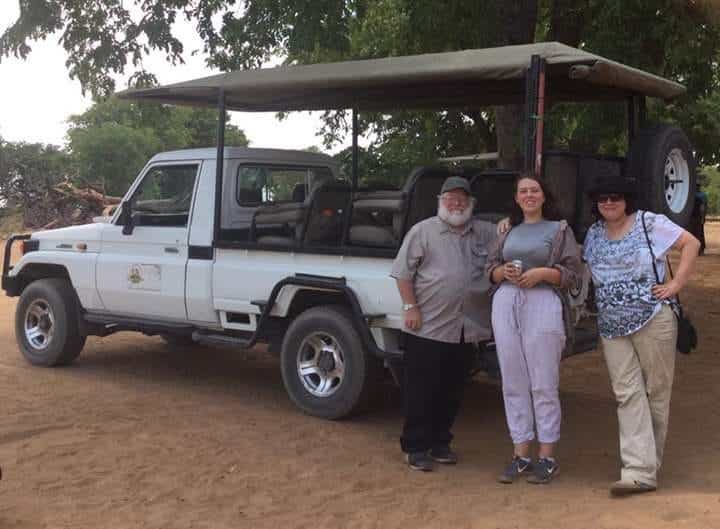
Webster eventually moved to Portland with his wife Karon, became an elementary school teacher, and the couple had three kids. But in November 2024, Webster’s life presented an obstacle he never could have anticipated. After being diagnosed with diabetes, he began rapidly losing weight and experiencing debilitating stomach pain. “Karon took me to urgent care, and I got a CAT scan,” he says. “And then it all happened very quickly.”
After seeing an oncologist in Portland, Webster was diagnosed with pancreatic cancer. “It was very matter-of-fact,” he recalls. “They told me I likely had about 15 months left.”
Pancreatic cancer is the third leading cause of cancer-related death in the United States, and has the highest mortality rate of all major cancers. That's primarily because most patients don’t show symptoms until the disease spreads: 85 percent of pancreatic cancer patients are diagnosed after the cancer has metastasized, making it extremely difficult to treat. Surgical removal is only possible in about one in five cases, and the five-year survival rate for the disease is currently around 13 percent.
While these statistics sound grim, a new test is offering hope for the future of earlier cancer detection. Blood-based multi-cancer early-detection (MCED) tests like Cancerguard® have recently hit the market, and have the potential to detect over 50 different cancer types and subtypes in their earliest stages. According to Tom Beer, MD chief medical officer of multi-cancer early detection at Exact Sciences, “Our test works by measuring for DNA alterations and cancer-related proteins in the bloodstream.” Even at the earliest stages, the Cancerguard test may be able to detect the tumor markers shed by certain cancers, making it possible for patients to be treated before the cancer spreads. “In the past, early detection has been limited to cancers we have screenings for: breast, colorectal, cervical, lung, and prostate,” continues Dr. Beer. “Cancerguard tests can help detect pancreatic, ovarian, gastric, esophageal — the ones that tend to sneak up on us.”

When reflecting on how his diagnosis came so late, Webster naturally feels frustrated. “Karon and I should have had 30 more years together,” he says. “I wanted to go to Thailand and Scotland with her, to see the Great Wall of China. I wanted to write more. But most of all, I want to meet my kids’ babies, to rock them in my arms, and be a grandpa.”
Knowing that he likely won’t be around to make those memories with his own family has made Webster a passionate advocate for the Cancerguard test. “It’s incredible this test exists now, and I think everyone should get it,” he says. “I hope it allows more people to avoid this disaster in their lives. Catching cancer early with a test like this gives you time to fix the track, so hopefully the train doesn't go off the cliff.”
While MCED tests could be revolutionary for outcomes in cancers that don’t currently have screening methods available, Dr. Beer emphasizes that they aren't intended to replace existing screening methods: “Mammograms, cervical cancer screening, colorectal cancer screening, and lung cancer screening for smokers are tests designed for a single cancer,” explains Dr. Beer. “They work really well and are highly sensitive. This blood test will not replace them, but will hopefully be an additional tool for early detection.”
Although Webster wasn’t able to benefit from a tool like Cancerguard, he looks back on his life with very few regrets. “If we’re put on this earth to do something that matters, I feel like I've done that as a teacher,” he says. “I think I was a good teacher, and that I was a positive influence on a lot of young lives. And that to me is a sign of a life well-lived.”
With the time he has left, Webster intends to spend as much of it as possible with his family. His two sons, now in their 20s, have moved home to be with him, and his daughter Janet is currently helping him illustrate the prequel for his book trilogy. “It’s been very special, getting to spend all of this time with the three of them,” he says. “This diagnosis has given me the time to re-meet my kids as adults, and what a blessing that is.” While his cancer isn’t genetic, Webster feels a relief knowing that his children will have access to a test like Cancerguard: “I wish I could rewind my own life to be able to take the test,” he says, “But knowing it’ll be available for my kids is a huge weight off my shoulders.”

When it comes to his children, Webster’s hope for their future is simple: “I want them to always have some sort of magic in their lives,” he says. “To look out of the corner of their eye and see a little dragon or an elf there… To know that they'll always maintain a sense of wonder, that’s important to me.” And if the world ever feels too heavy, he hopes they’ll open one of his books — because even when he can’t be with them, the magic he made will be.
Randy Webster passed away on January 24th, 2026. He is survived by his wife, Karon, and their three children.
The Cancerguard test was developed, and the performance characteristics validated by Exact Sciences Laboratories following College of American Pathologists (CAP) and Clinical Laboratory Improvement Amendments (CLIA) regulations. This test has not been cleared or approved by the US Food and Drug Administration. The test is performed at Exact Sciences Laboratories. Exact Sciences Laboratories is accredited by CAP, certified under CLIA regulations, and qualified to perform high-complexity clinical laboratory testing.
