






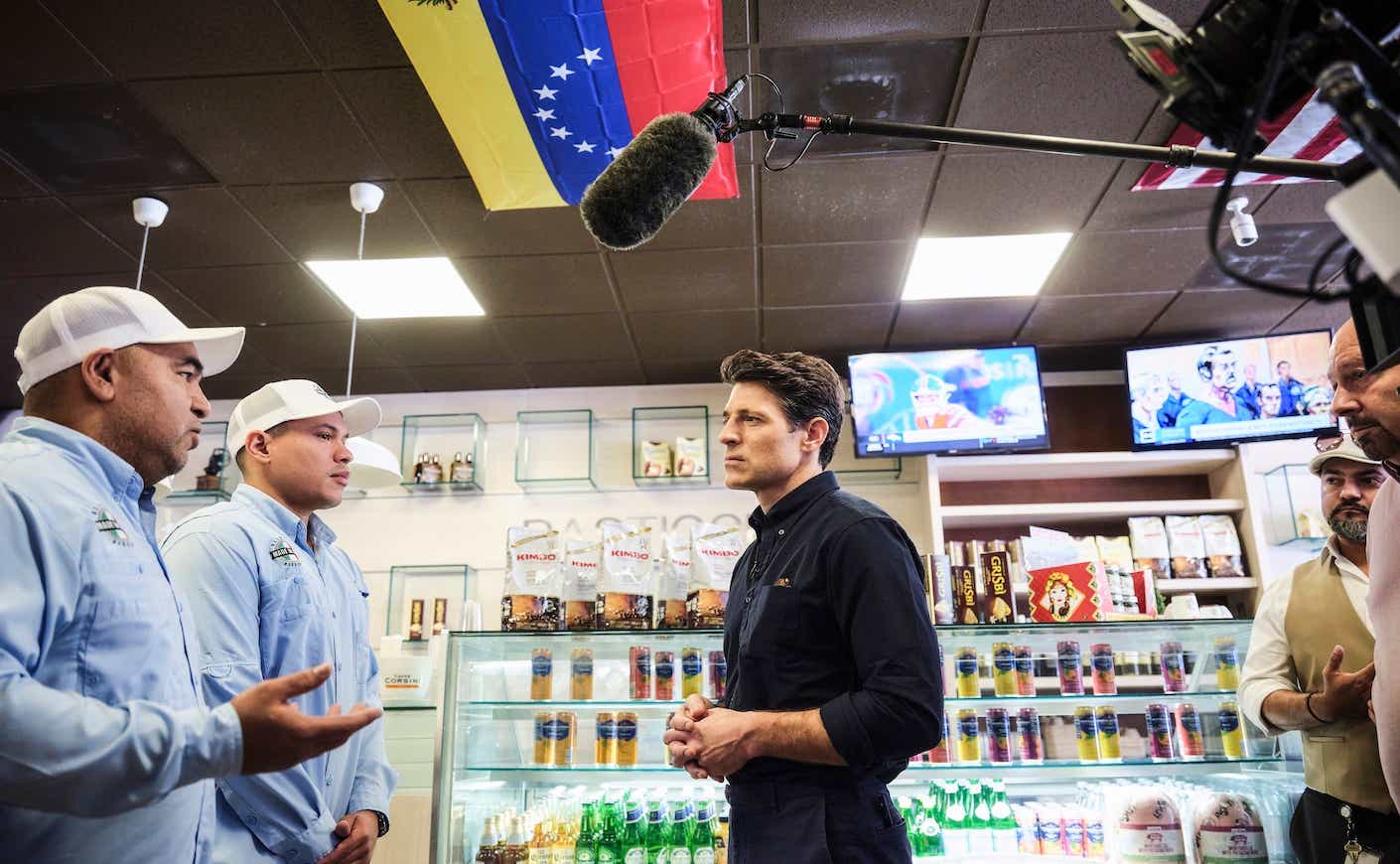
The CBS Evening News is making a lot of headlines this week — and not necessarily the kind the network wants. As someone who held the anchor position from 2006 to 2011, I’ve been watching closely and have some thoughts, which I'll share another time. For now, I asked my friend Jeff Jarvis, who’s been writing for decades about the fourth estate, to give us his thoughts not just on who is anchoring the news — Tony Dokoupil — but how that news is being reported. Here's his analysis. - KC
It would be easy to mock Tony Dokoupil’s debut as the latest anchor of the CBS Evening News by cataloguing embarrassing moments that resulted:
- In his rushed weekend premiere the night following U.S. capture of Venezuelan President Nicolás Maduro, Dokoupil fumbled elementary grammar at the start: "Commandos raiding his compound before dawn, grabbing he and his wife in their pajamas." Make that "grabbing him." And at the end: "Was the president’s actions legal?" Make that the plural "were."
- In his official debut on Monday, Dokoupil got flummoxed when he thought he would next read a report on Minnesota Governor Tim Walz dropping out of his reelection race. But the screen beside him showed Arizona Senator Mark Kelly. An experienced anchor would feint. Dokoupil almost fainted. After dead air, he muttered, "First day, big problems here. Are we going to Kelly here?" You won’t see the flub online; the segment was rerecorded.
But to poke at such trivial missteps would be to miss the much deeper problems with the show’s journalism and the implications for the fate of CBS News, the form of the evening news itself, and the destiny of mass media. Here are more seriously troubling moments from his first episodes:
- The weekend premiere featured an interview with Pete Hegseth (at least the screen identified him as Secretary of Defense instead of Trump’s imagined title, Secretary of War). The triumphal appearance stretched over three blocks, giving one official unprecedented airtime — nine minutes out of a 22-minute program — to issue nothing but the administration line (“I saw the best of America”), met with wiffle-ball questions (“Is it about freedom or is it about oil?”). In reaction to the capture, Dokoupil noted only “cheers...from Caracas to Miami,” without reporting on protest and dissent.
- On the Monday show, in a segment about continuing cuts in vaccine recommendations by the Centers for Disease Control and Prevention, Dokoupil began: “There are parents out there who are celebrating this.” There are more doctors and experts lamenting it. This time, the show presented the immensely controversial party line from Health and Human Services Secretary Robert F. Kennedy Jr., again without proper reporting of concern and dissent.
- The next night, two more members of the Trump cabinet got their turns on the CBS stage. Secretary of Homeland Security Kristi Noem — in her cop-cosplay uniform — would not comment on her boss’ intentions with ICE deportations: “I’m focused on policing the streets, not policing President Trump’s words.” For a lighter note, Dokoupil ended the show by marking “the many lives and many jobs” of Secretary of State Marco Rubio — possibly now including running Venezuela — and said: “Whatever you think of his politics, you gotta admit it is an impressive resume…Marco Rubio, we salute you. You’re the ultimate Florida man.” The fifth anniversary of the January 6 siege on the Capitol received scant mention.
Dokoupil, formerly cohost of CBS Mornings, was handpicked as anchor by the new head of CBS News, Bari Weiss, a former columnist who walked out of The New York Times in a public huff five years ago to found The Free Press, which was bought for a reported $150 million by the network’s new owners, Larry and David Ellison, major donors and allies of Trump’s.
Weiss fancies herself heterodox — that is, unorthodox and contrarian. She vows to counteract the allegedly liberal heritage of American media and particularly CBS News — the network of Edward R. Murrow, Walter Cronkite, Dan Rather, and Katie Couric — by purging it of wokeness. For his part, Dokoupil is positioning himself as an anti-intellectual populist, declaring in a shirtsleeved video: “On too many stories, the press has missed the story, because we've taken into account the perspective of advocates and not the average American. Or we put too much weight in the analysis of academics or elites, and not enough on you.” When pressed on social media to address his dismissal of academics, Dokoupil defended himself by quoting...a Columbia professor of his.
"I report for you."
The new CBS Evening News launches on Monday and our new anchor, Tony Dokoupil, is making a promise to viewers: "You come first. Not advertisers. Not politicians. Not corporate interests."
From now on, what you see and hear on the news will reflect what you… pic.twitter.com/WMAjnRI1wv— CBS News (@CBSNews) January 1, 2026
In any event, the new CBS Evening News is neither heterodox in its perspectives nor a platform for diverse debate or vox pop(ulism). Instead, as evidenced by these first outings of the new Evening News, Weiss and Dokoupil are producing state propaganda.
They have hammered the last nail in the coffin of CBS News as respected journalism. Weiss killed the network’s reputation when she pulled a 60 Minutes report on conditions in El Salvador’s CECOT prison, where the US has been sending deportees. As Katie said at the time, “This is what happens when network owners are beholden to an administration for their business transactions.”
What she’s referring to is the Ellisons’ effort to next buy Warner Bros. Discovery and with it, CNN. It is presumed that Weiss would next take charge of the news network, and the Ellisons have reportedly told Trump they would clean house of anchors he dislikes.
If that happens, let us take stock of the state of legacy mass media in America. Fox, its stations and news network, and the Wall Street Journal are in the hands of the Ellisons’ role models, the right-wing Murdoch family. CBS News and CNN would look and sound like Fox. ABC’s owner, Disney, showed it could be cowed by Trump into pulling Jimmy Kimmel off the air (and ABC News is already adding Trump’s name to that of the Kennedy Center). Jeff Bezos’s Washington Post has taken a hard turn toward Trump. Even The New York Times, as I have written, seems to make sport of disappointing liberal subscribers. Elsewhere, most newspaper chains are controlled by hedge funds and private equity, which are cutting them to the marrow. The conservative Sinclair Broadcast Group owns 185 TV stations in 85 local markets — and is trying to buy more. Meanwhile, as I’ve also written, magazines as a genre and industry are fading away. In sum: Mass media are dead and dying.
In Cronkite’s last full year as anchor of the CBS Evening News, the show was No. 1 in news, watched by almost 16 million viewers — seven percent of the population at the time. Last month, the show was watched by 4.36 million people — a mere 1.25 percent of the nation. And that audience is geriatric. Their median age is 58, and Evening News attracts only half a million viewers in the prized 25-54 age demographic.
So should we even care about the ruin of the Tiffany network? Yes, to the extent that legacy news organizations still employ qualified journalists, and so long as big, old media still act as both source and amplifier for public discourse.
But the future will not be televised. YouTube and TikTok are where anyone under the age of, say, 50 watches a new kind of news. Independent sites like the one you are reading now play an important role in the new news ecosystem, alongside countless newsletters, community websites, podcasts, and blogs.
The age of mass media was a temporary phenomenon. At the turn of the last century, in 1900, New York City alone boasted 46 daily newspapers, alongside scores of weekly and monthly publications. That, I believe, is a more natural state of media in a pluralistic society. That is what we are returning to: messy, spiky, chaotic, and more representative of the nation we live in.
Very few people will watch Dokoupil’s and Weiss’s CBS Evening News. After the current fuss dies down, as fusses do, very few will talk about it. What is being done to a once-proud institution is a crying shame. But in truth, it doesn’t matter anymore.
Jeff Jarvis is emeritus professor of journalism innovation at CUNY, visiting professor at Stony Brook, a fellow at Montclair State, and author of the upcoming book, Hot Type: The Magnificent Machine that Gave Birth to Mass Media and Drove Mark Twain Mad.
